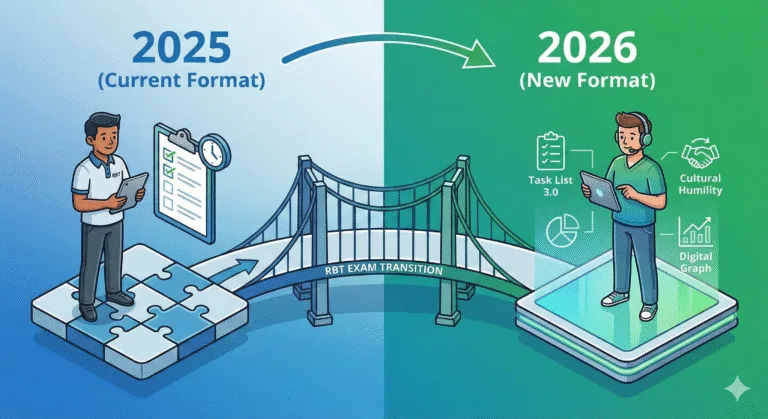
Updated September 2026 to reflect the RBT Test Content Outline (3rd Edition) and the 2026 BACB RBT Handbook.
If you’re thinking about becoming a Registered Behavior Technician (RBT), there’s one major milestone standing between you and that goal: the Pearson VUE RBT exam.
This exam is a computer-based test designed to prove that you’ve got the foundational skills to support individuals with behavioral needs, all under the guidance of a Board Certified Behavior Analyst (BCBA).
And yes: it can feel intimidating at first.

This guide walks you through exactly what to expect. We’ll break down the exam format, what content areas you’ll be tested on, how scoring works, and the best study strategies to set yourself up for success.
Whether you’re still in training or already scheduling your test date, this overview is built to help you pass: confidently, and ideally, on your first attempt.
Let’s get into it.
What Is the Pearson VUE RBT Exam?
The Pearson VUE RBT exam is a test you must pass to become a Registered Behavior Technician (RBT). This exam is required to prove that you’ve learned the skills needed to follow a behavior plan, help clients, and support families.
Most RBTs work under the supervision of a BCBA (Board Certified Behavior Analyst) or BCaBA (Board Certified Assistant Behavior Analyst).
Exam Format and Structure
The RBT exam is a computer-based test taken in person at an authorized Pearson VUE center.
- Length, duration, number of questions.
The RBT exam takes 90 minutes to finish. You’ll answer 85 multiple-choice questions. Out of these:
- 75 questions are scored (they count toward your final result).
- 10 questions are unscored. These are test questions for future exams. You won’t know which ones are unscored, so take every question seriously.
Each question gives you four answer choices, but only one is correct.
- Delivery method (test centers, online proctored).
The RBT exam is given in person at a Pearson VUE testing center. As of September 1, 2023, you can no longer take the exam online. You’ll take the test on a computer. You can’t use a calculator, phone, or notes. Everything you need will be on the screen.
- Adaptive or fixed?
The RBT exam is a fixed-form test. Several forms are in use at the same time, and you’re assigned one at random, so you may not see the same questions as someone else. It’s not adaptive, so your answers don’t change what you see next.
Pearson VUE RBT Exam Content Breakdown
The RBT exam covers six content areas based on the RBT Test Content Outline (3rd Edition), which replaced the RBT Task List (2nd Edition) on January 1, 2026. The outline lists 43 tasks, and every scored question maps to one of them.
Here’s what to expect (question counts are out of the 75 scored items):
- A. Data Collection and Graphing (was Measurement)
13 questions (about 17%). You’ll need to know how to:
- Collect data with continuous methods (frequency, rate, duration, latency, IRT) and discontinuous methods (partial and whole interval, momentary time sampling)
- Enter and record data correctly and consistently
- Graph data and describe what a graph shows
This section makes sure you can track behavior change the right way.
Take the Free Data Collection and Graphing (Measurement) Quiz
- B. Behavior Assessment (was Assessment)
8 questions (about 11%). You’ll need to know how to:
- Help run preference assessments (to see what a client is likely to work for)
- Assist with functional behavior assessments (to learn why a behavior happens)
- Support your BCBA with skill assessments
Take the Free Behavior Assessment Quiz
- C. Behavior Acquisition (was Skill Acquisition)
19 questions (about 25%). You’ll need to know how to:
- How to use discrimination training
- How to use reinforcement, including token systems
- Teaching methods such as discrete-trial teaching, naturalistic teaching, prompting and fading, shaping and chaining
- How to help clients generalize and maintain skills
This is the biggest section on the test.
Take the Free Behavior Acquisition (Skill Acquisition) Quiz
- D. Behavior Reduction
14 questions (about 19%). You’ll need to know how to:
- How to follow behavior-reduction plans
- Techniques such as differential reinforcement and extinction
- Crisis and emergency procedures, and staying consistent and safe while following your supervisor’s plan
Take the Free Behavior Reduction Quiz
- E. Documentation and Reporting
10 questions (about 13%). You’ll need to know how to:
- Report things that might affect client progress, like illness or schedule changes
- Write objective session notes
- Communicate clearly with your supervisor
Being accurate and timely is key in this part of the job.
Take the Free Documentation and Reporting Quiz
- F. Ethics (was Professional Conduct and Scope of Practice)
11 questions (about 15%). You’ll need to know how to:
- The RBT Ethics Code (2.0) and professionalism
- Keeping client information private
- Knowing your role, supervision requirements, and when to ask your supervisor for help
It makes sure you work safely, legally, and respectfully.
Take the Free Ethics (Professional Conduct) Quiz
Each area appears in the test in proportion to its weight. Behavior Acquisition gets the most attention, while Behavior Assessment has the fewest questions. Your result is based on overall performance, not a minimum score per area. Use the Test Content Outline (3rd Edition) to guide your studying.
Scoring System Explained
The RBT exam is criterion-referenced and reported as pass or fail.
- What Is the Passing Score?
The BACB does not publish a passing percentage or a numeric score. Your report shows pass or fail only. So don’t chase a magic number. Aim to score well in every content area on full-length mocks.
- How the Passing Standard Is Set
Here’s how it works:
- Each test form may contain slightly different questions.
- A panel of behavior analysis experts uses the modified Angoff method to decide how many correct answers a minimally qualified RBT should get on that form.
- The 10 unscored pilot questions are mixed in and do not count toward your result.
- Because the standard is set per form, a slightly harder form needs slightly fewer correct answers, and an easier one slightly more.
You will not see how many questions you answered correctly. If you fail, the report lists the RBT tasks where you answered questions incorrectly, so you know what to study before a retake.
RBT Exam Pass Rate
The RBT exam has a relatively high pass rate compared to other ABA certification exams. Over the last four years, about 73% to 77% of first-time test takers passed.
In 2025, 75% of first-time candidates passed (109,341 tested, per the BACB annual data). This shows that with the right training and focus, most people pass on their first try.
- First-time vs retake pass rate
There’s a big difference between first-time and retake pass rates. In 2025:
- First-time pass rate: 75%
- Retake pass rate: Only 38%
This means it’s much better to be fully prepared before your first attempt. The chances of passing drop sharply if you have to retake it.
How Hard Is the Pearson VUE RBT Exam?
The RBT exam is often seen as more manageable than other behavior analysis certifications. Why?
- It covers entry-level material only (from the RBT Test Content Outline, 3rd Edition)
- All questions are multiple choice
- You don’t need advanced math or a college degree to understand the content
The national first-time pass rate (73% to 77% from 2022 to 2025) supports this: most prepared candidates pass on the first try.
- Areas many learners find hard in practice
Still, the test isn’t “easy.” In practice, many learners struggle with:
- Data Collection and Graphing
Reading graphs, calculating percentages, or knowing when to use continuous vs. discontinuous recording - Behavior Reduction Strategies
Choosing the right intervention (like differential reinforcement, extinction, or antecedent interventions like NCR) - Ethics
Scenario-based questions on confidentiality, boundaries, or scope of practice can be tricky without reviewing the BACB Code
Proven Strategies to Pass the RBT Exam
Candidates improve their chances by combining content review with smart study techniques. Key strategies include:
- Review the BACB’s RBT Test Content Outline (3rd Edition)
The RBT Test Content Outline (3rd Edition) is your official roadmap: everything on the exam comes from its 43 tasks. Download it from the BACB website and study each of the six content areas carefully. Pay close attention to the terminology in each task. It is not just a checklist, it is the blueprint of your exam.
- Practice with Realistic Mock Tests
Use full-length, timed practice exams to simulate real testing conditions. The goal is to build comfort with pacing and question structure. Focus on question banks that explain the reasoning behind each answer: knowing why an option is right or wrong deepens your understanding. Multiple platforms and prep providers offer these, and they’re one of the most effective tools for retention.

- Use Flashcards for Key Terms
Turn terms like positive reinforcement, discontinuous measurement, and extinction into flashcards. Use active recall (testing yourself without looking) and spaced repetition (reviewing at increasing intervals): these two techniques are scientifically proven to lock information into long-term memory. Tools like Anki or Quizlet make it easy to organize and automate your review.
- Study Scheduling (Pomodoro, spaced repetition)
Avoid cramming. Instead, follow a structured plan with short, focused study sessions: the Pomodoro method (25 minutes study, 5-minute break) works well. Rotate topics across the week using distributed practice, and be sure to revisit your weaker areas often. Consistency beats intensity.
- Join Reddit/FB Study Communities
Don’t study in a vacuum. Join communities like r/RBT on Reddit or dedicated Facebook groups. You’ll find shared resources, explanations, and motivational support. These spaces often post mnemonics, tricky questions, and test-day tips that help reduce anxiety and sharpen your focus.
- Use Video Tutorials and Visual Learning
Supplement reading with videos and demos. Watching someone conduct a discrete trial, record data, or implement reinforcement makes the concepts click faster. Combine this with role-play practice: act out sessions with a peer or mentor. The RBT exam often includes scenario-based questions, so practical exposure strengthens applied reasoning.
Test Day: What to Expect at Pearson VUE Centers
Arrive at the Pearson VUE testing center at least 30 minutes early to complete the mandatory check-in procedures.

You’ll undergo a series of security checks, including:
- A digital photo
- Palm vein scan
- Electronic signature
- Confirmation of your IDs and registration details
These measures ensure test integrity and candidate identity verification. Late arrivals may be denied entry, so punctuality is non-negotiable.
- What to bring/not bring
You would be required:
- One form of valid ID
- It must be government-issued, original and current, with your photo and signature (e.g., driver’s license, passport)
- You only need one ID. It’s the only item you take into the testing room, besides your locker key.
- It must be government-issued, original and current, with your photo and signature (e.g., driver’s license, passport)
- Your name must match your BACB registration exactly: no mismatches or nicknames.
Not Allowed:
- Phones, smartwatches, wallets, keys, notes, books, calculators, or food/drink
All personal belongings must be stored in provided lockers before entering the testing room. You’ll be given a dry-erase board instead of scratch paper.
If You Fail the RBT Exam: What’s Next?
Failing the RBT exam isn’t the end: it’s a temporary hurdle. The BACB allows up to 8 attempts within your 12-month eligibility period. You must wait a minimum of 7 calendar days after your exam before you can take the exam again.
To retake:
- Submit the free Examination Retake Application through your BACB account.
- This form becomes available within 48 hours of a failed attempt.
You’ll schedule your next exam through your Pearson VUE account after the waiting period.

Important: If you reach 8 failed attempts, you must wait until your 12-month window ends before you can reapply. If your 12-month window expires, you must start the application process from scratch as a new candidate.
- Cost of retake
There is no fee to submit the BACB’s retake application. However, you will still need to pay the standard testing fee when scheduling the new exam through Pearson VUE.
- How to analyze your score report
Use your score report strategically. While BACB doesn’t release the number of correct answers, if you fail, your report lists the RBT tasks where you answered questions incorrectly. Here’s how to use it:
- Find the content areas those tasks belong to (e.g., Data Collection and Graphing, Behavior Reduction).
- Revisit the RBT Test Content Outline (3rd Edition) and focus your review on those weak spots.
- Supplement your study with targeted practice quizzes, videos, and applied examples.
Pro tip: Don’t just re-read material: use active recall, spaced repetition, and mock testing to improve performance.
FAQs
- Can I take the exam online?
No. The BACB delivers the RBT exam in person only, at authorized Pearson VUE testing centers (RBT Handbook, updated June 2026).
- How soon can I schedule after training?
After completing the required 40-hour ABA training and submitting your RBT application, the BACB will review your materials. Once approved, you will receive an Authorization to Test (ATT) email (usually within 1–2 weeks). At that point you can log into your Pearson VUE account to schedule the exam. You cannot schedule before receiving the ATT.
- Does the certification expire?
Yes, and the cycle is changing. RBTs who recertify in 2026 complete the Recertification Competency Assessment one more time and then move to a two-year cycle; RBTs first certified in 2026 receive a two-year certification. From 2028 onward, recertification requires 12 professional development units per two-year cycle and no competency assessment. The recertification application fee is $50. If you miss your date you become inactive for a 30-day reinstatement window, after which the certification expires and you must reapply and retest. See the BACB RBT Handbook for the current rules.
Conclusion
The RBT exam is your gateway to a rewarding career in behavior analysis.
Success comes down to three things:
- Understanding the RBT Test Content Outline (3rd Edition)
- Practicing with realistic questions
- Following a structured study plan.
Remember the key facts. The result is pass or fail with no published percentage, so aim well above 80% on practice tests. In 2025, 75% of first-time candidates passed, but only 38% of retakers did.
Focus on your weak areas, and give a free RBT Practice quiz to judge your knowledge.
Start studying early and stay consistent. Join study communities for support and use active recall techniques like flashcards and mock tests.
Wondering what score you need? Here’s how the RBT exam passing score works.