By Free RBT Practice Test Editorial Team | Updated September 2026
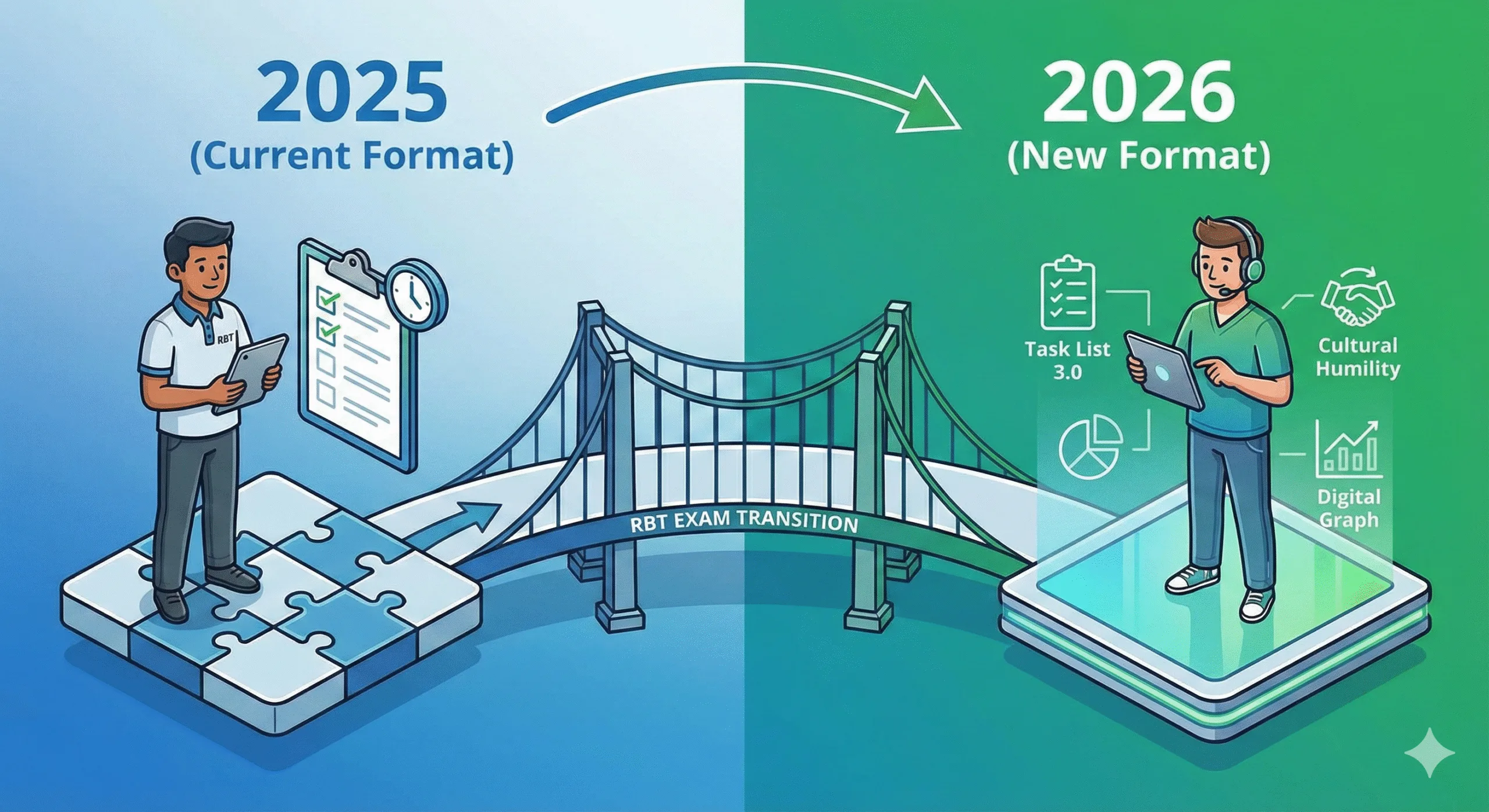
On January 1, 2026, the BACB switched the RBT exam to the RBT Test Content Outline (3rd ed.), which covers 43 tasks in six content areas, four of them renamed. The same date brought a new 40-hour training curriculum, an updated Initial Competency Assessment, new fees, and a two-year recertification cycle. The exam itself is still 85 questions in 90 minutes, so what changed is the content you are tested on and the rules around getting and keeping the credential, not the test format.
Sources for every number on this page: the BACB RBT Handbook (updated 06/2026) and the BACB’s Guidance for Meeting RBT Requirements During the 2026 Transition (08/2025). Where we could not confirm something from those two documents, we say so.
The six content areas and their weights
The 75 scored questions are split across six content areas. Questions are equally weighted and your result is based on overall performance, not on each area separately, so a weak area can be offset by a strong one.
| Area | Content area (3rd ed.) | Old name (2nd ed.) | Tasks | Scored questions | Share of exam |
| A | Data Collection and Graphing | Measurement | 8 | 13 | 17% |
| B | Behavior Assessment | Assessment | 3 | 8 | 11% |
| C | Behavior Acquisition | Skill Acquisition | 11 | 19 | 25% |
| D | Behavior Reduction | Behavior Reduction | 7 | 14 | 19% |
| E | Documentation and Reporting | Documentation and Reporting | 4 | 10 | 13% |
| F | Ethics | Professional Conduct and Scope of Practice | 10 | 11 | 15% |
| Total | 43 | 75 | 100% |
Sources: BACB RBT Handbook, Examination Outline table (questions), and the RBT Test Content Outline (3rd ed.) (tasks). Areas C and D together make up 44% of the scored questions, so teaching and behavior-reduction procedures deserve the largest share of your study time.
What changed from the 2nd Edition
- New outline, new name. The 2nd-edition “RBT Task List” is now the “RBT Test Content Outline (3rd ed.)”. Every RBT exam taken in 2026 or later is based on the new outline.
- Task count went from 37 to 43. Data Collection and Graphing grew from 6 tasks to 8, Behavior Reduction from 6 to 7, and Ethics from 5 to 10. Behavior Acquisition dropped from 12 to 11 and Documentation and Reporting from 5 to 4.
- Four areas were renamed. Measurement became Data Collection and Graphing, Assessment became Behavior Assessment, Skill Acquisition became Behavior Acquisition, and Professional Conduct and Scope of Practice became Ethics.
- Task IDs use dots, not hyphens. Look for A.1 through F.10 in study materials. A guide that still lists tasks as A-01 or F-05 was written for the 2nd edition.
- Ethics doubled in task count. With 10 tasks and 11 scored questions, Ethics now carries more weight than Behavior Assessment. Expect questions on confidentiality, boundaries, gifts, and cultural responsiveness. The Handbook’s sample ethics question is a short scenario, so practice applying the rules, not just defining them.
- The old transition allowance has run out. Applications approved before January 1, 2026 stayed valid for 12 months without the new training or competency assessment, but the exam itself has been the 3rd-edition exam since January 1, 2026. Anyone applying now must meet the 2026 requirements in full.
Exam format that did not change
- 85 multiple-choice questions: 75 scored and 10 unscored pilot questions that you cannot tell apart from the scored ones.
- Four answer options, one correct answer.
- 90 minutes total, and that time includes reading the terms and conditions and the tutorial.
- Delivered in English only, in person at Pearson VUE test centers.
- Result is pass or fail. The passing standard is set with the modified Angoff method, a criterion-referenced approach that judges each question by how a minimally qualified RBT would perform. The BACB does not publish a passing percentage or a passing scaled score, so any site that quotes one is guessing.
- Retakes: up to 8 attempts within 12 months of your application approval, with a 7-day wait between attempts and no retake fee listed in the current handbook.
You see your pass/fail result at the test center, and the BACB confirms it by email and in your account within about a week.
2026 eligibility changes
If you are applying now, you need all of the following:
- Age and education. At least 18 years old with a high-school education or equivalent, confirmed on the RBT Certification Application Attestation form signed by an attesting certificant no more than 90 days before you pay for your application.
- Background checks. A criminal background check and an abuse registry check, each completed no more than 180 days before you pay for your application.
- 40-hour training on the 2026 curriculum. The training must follow the RBT 2026 40-Hour Training Requirements and Curriculum Outline and be completed in no fewer than 5 days and no more than 180 days (start and end dates count). Your certificate must state that the program is designed to meet the 2026 training eligibility requirement. Trainers must be active BCBAs or BCaBAs who have completed the 8-hour supervision training. There is no bridge course: if your training was on the 2nd edition and your application approval has expired, you retake the full 40 hours.
- RBT Initial Competency Assessment (2026 version). Completed after training and no more than 90 days before you apply. It covers 19 tasks across measurement, assessment, skill acquisition and behavior reduction, and professionalism, some with a client and some by interview. Nobody assessing you may be related to you, subordinate to you, or employed by you. See our competency assessment guide for the full list of 19 tasks.
- Fees. $65 certification application processing fee paid to the BACB, plus $45 per exam appointment paid to Pearson VUE. Rescheduling costs $27 if you change 30 to 5 days before the appointment, $32 if you change between 5 days and 48 hours before, and nothing if you change 31 or more days out. Inside 48 hours there is no change or refund.
- Application validity. Your application stays active for 90 days. Miss a requirement inside that window and you reapply and pay again. Allow about two weeks for processing, then you have one year from approval to pass the exam.
After you pass, your certification starts inactive until an RBT Supervisor or RBT Requirements Coordinator adds you as a supervisee. There is no paper certificate; the registry updates within about 24 hours.
Recertification transition
The transition guidance lays out a three-year path:

- 2026. Current RBTs recertify one more time with the RBT Recertification Competency Assessment. That recertification moves them to a two-year cycle. RBTs certified for the first time in 2026 get a two-year window from the start.
- 2027. Nobody who recertified in 2026 has to recertify in 2027. Recertification applications become available within 45 days of your recertification date once your PDUs are entered.
- 2028 and after. You submit 12 professional development units (PDUs) per two-year cycle and no competency assessment. PDUs come from in-service training at your employer (delivered by a BCaBA, BCBA, or BCBA-D), ACE-provider events, or university behavior-analytic coursework passed with a C or better. Repeated events, supervision hours, and client-specific training do not count.
- Fee. The two-year recertification application processing fee is $50 from January 1, 2026. A late application costs another $50. If you miss your date, you have a 30-day reinstatement period while your certification sits inactive; after that it expires and you must reapply and retake the exam.
- Supervision is unchanged. You still need supervision for at least 5% of the hours you spend providing services each calendar month, including two face-to-face contacts, at least one of them individual.
How our free tests map to the 3rd Edition
Our free RBT practice tests follow the six 3rd-edition content areas. Our five full-length mock tests have 75 questions each, the same number as the scored items on the real exam, so practice pacing yourself at about one minute per question. The six area quizzes let you drill one weak spot at a time:
- Data Collection and Graphing (Area A, 17%)
- Behavior Assessment (Area B, 11%)
- Behavior Acquisition (Area C, 25%)
- Behavior Reduction (Area D, 19%)
- Documentation and Reporting (Area E, 13%)
- Ethics (Area F, 15%)
A sensible order is to take one full test first, then spend time on the areas where you scored lowest, then take a second full test under timed conditions. Before your appointment, read our exam day guide, and if you keep missing questions that look easy, work through our tricky RBT questions.
Sample quiz: 10 questions in the 3rd-edition style
The sample questions in the RBT Handbook are short scenarios, and so are these. Cover the answers and try them.
1. (Area A) During a 45-minute session, an RBT counts 9 instances of a client throwing materials. What rate should she record?
A. 9 per session
B. 12 per hour
C. 20 per hour
D. 5 per hour
Answer: B. Rate is count divided by time: 9 responses in 0.75 hours is 12 per hour.
2. (Area A) An RBT looks at a line graph of a client’s independent hand-washing over ten sessions. The data path rises steadily from left to right. How should he describe it to his supervisor?
A. The data show an increasing trend
B. The data show high variability
C. The data show a decreasing level
D. The data show no change
Answer: A. A data path that moves consistently in one direction across sessions is a trend; a steady rise is an increasing trend.
3. (Area B) A supervisor asks an RBT to present two snack items at a time, record which one the client reaches for, and repeat with every possible pair. Which preference assessment is this?
A. Free operant observation
B. Multiple stimulus without replacement
C. Paired stimulus (forced choice)
D. Single stimulus
Answer: C. Presenting items in pairs and recording the choice for every combination is the paired-stimulus, or forced-choice, method.
4. (Area C) A client can wash his hands when the RBT gives a full physical prompt. The plan says to move to a partial physical prompt, then a gestural prompt, then no prompt. What is this procedure called?
A. Most-to-least prompt fading
B. Least-to-most prompting
C. Shaping
D. Backward chaining
Answer: A. Starting with the most intrusive prompt and systematically reducing it is most-to-least prompt fading.
5. (Area C) A client says “wa” to ask for water. The plan tells the RBT to now deliver water only for “wa-ter” and to no longer reinforce “wa” alone. Which procedure is the RBT using?
A. Chaining
B. Shaping
C. Discrimination training
D. Extinction of the mand
Answer: B. Reinforcing a closer approximation while withholding reinforcement for the earlier form is shaping.
6. (Area D) A client’s screaming used to get the RBT to hand over the tablet. The plan now puts screaming on extinction. In the first session, screaming gets louder and lasts longer than before. What should the RBT do?
A. Give the tablet to calm the client
B. Continue the plan as written and record the data
C. Stop the session and end early
D. Add a reprimand each time the client screams
Answer: B. A temporary increase in the behavior is an extinction burst; giving in would reinforce the louder screaming, so the RBT follows the plan and reports the data.
7. (Area D) A client loses one token from his board each time he hits a peer, according to the behavior plan. Which procedure is this?
A. Positive punishment
B. Negative reinforcement
C. Response cost (negative punishment)
D. Differential reinforcement of other behavior
Answer: C. Removing a reinforcer (a token) contingent on behavior to reduce that behavior is response cost, a form of negative punishment.
8. (Area E) Which sentence belongs in a session note?
A. “Client was in a bad mood and did not want to work.”
B. “Client engaged in 4 instances of dropping to the floor during table work; each lasted under 30 seconds.”
C. “Client was being manipulative to avoid demands.”
D. “Client probably did not sleep well last night.”
Answer: B. Session notes describe observable, measurable behavior; A, C, and D are interpretations or guesses.
9. (Area F) A client’s parent sends the RBT a friend request on social media and offers a $75 gift card “for all your hard work.” What should the RBT do?
A. Accept both to maintain rapport
B. Accept the gift card but decline the friend request
C. Politely decline both and tell her supervisor
D. Accept the friend request only, since it costs nothing
Answer: C. A social-media connection creates a multiple relationship, and a $75 gift card is well over the RBT Ethics Code’s $10 gift limit (Standard 1.11); the RBT declines both and informs the supervisor.
10. (Area F) A parent asks the RBT to change the reinforcement schedule in the plan because “it isn’t working at home.” What is the correct response?
A. Change the schedule so the family stays engaged
B. Explain that only the supervisor can modify the plan and pass the request on
C. Tell the parent to try it herself and report back
D. Ignore the request since parents do not direct treatment
Answer: B. Modifying a behavior plan is outside an RBT’s scope; the RBT relays the concern to the supervising behavior analyst.
FAQ
When did the 3rd-edition RBT exam start?
January 1, 2026. Every exam taken on or after that date is built from the RBT Test Content Outline (3rd ed.). Applications approved before that date keep their 12-month window, so the last of those run out by the end of 2026.
How many questions are on the 2026 RBT exam and how long do I get?
85 multiple-choice questions, of which 75 are scored and 10 are unscored pilot items, in 90 minutes. The 90 minutes include the terms and conditions and the tutorial.
What score do I need to pass the RBT exam?
The BACB does not publish one. Results are pass or fail, and the passing standard is set with the modified Angoff method. Treat any “200 out of 250” or “80%” figure you see online as unverified.
What are the six content areas and how much is each worth?
Data Collection and Graphing 13 questions (17%), Behavior Assessment 8 (11%), Behavior Acquisition 19 (25%), Behavior Reduction 14 (19%), Documentation and Reporting 10 (13%), and Ethics 11 (15%).
Can I still use my 2nd-edition 40-hour training?
Only if your application was approved before January 1, 2026 and is still inside its 12-month window. Otherwise you need the full 2026 40-hour training (5 to 180 days) and the 2026 Initial Competency Assessment. There is no bridge course.
How much does it cost to become an RBT in 2026?
$65 to the BACB for the certification application and $45 to Pearson VUE for each exam appointment, plus whatever your training provider charges. Rescheduling inside 30 days costs $27 to $32.
How often do RBTs recertify now?
Every two years. RBTs who recertified in 2026 completed a final competency assessment and next recertify in 2028 with 12 PDUs. The two-year recertification fee is $50.
What happens if I fail?
You can retake the exam up to 8 times within 12 months of your application approval. You must wait 7 days between attempts and submit a retake application in your BACB account. It becomes available there within 48 hours of the failed attempt. The current handbook lists no retake fee, but each appointment is $45.
Sources and scope
This article uses only the BACB RBT Handbook (06/2026) and the 2026 transition guidance. We did not confirm 40-hour training prices, which vary by provider, and we did not check state licensing rules, which are separate from BACB certification. Check the BACB site for changes after our review date.