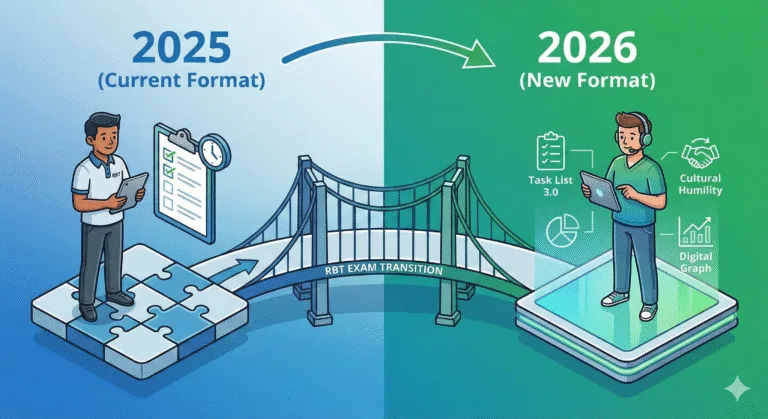
Updated September 2026 to reflect the 2026 BACB RBT requirements (RBT Handbook, updated June 2026).
25% of first-time candidates didn’t pass the RBT exam in 2025, according to BACB data.
And the exam is only one step. Before you can even apply to take it, you have to pass the hands-on RBT Initial Competency Assessment.
You’ve spent weeks completing your 40-hour training. You’ve memorized every term in the RBT Test Content Outline. You can recite the principles of applied behavior analysis in your sleep.
But here’s the thing: this RBT initial competency assessment isn’t about what you know. It’s about what you can DO.
The RBT Competency Assessment is your make-or-break moment.
And if you’re reading this, you’re probably feeling that familiar mix of excitement and terror that comes with knowing your career hangs in the balance.
With the right preparation, the right mindset, and the right information, you can walk into that rbt competency assessment room confident and ready. This guide will show you exactly how.
In this blog, we’ll explain what the RBT Competency Assessment is, go over the important skills you need to learn, specific domains, share tips to help you do well, and show you the best study materials to get ready.
Let’s dive in.
Overview of the RBT Competency Assessment
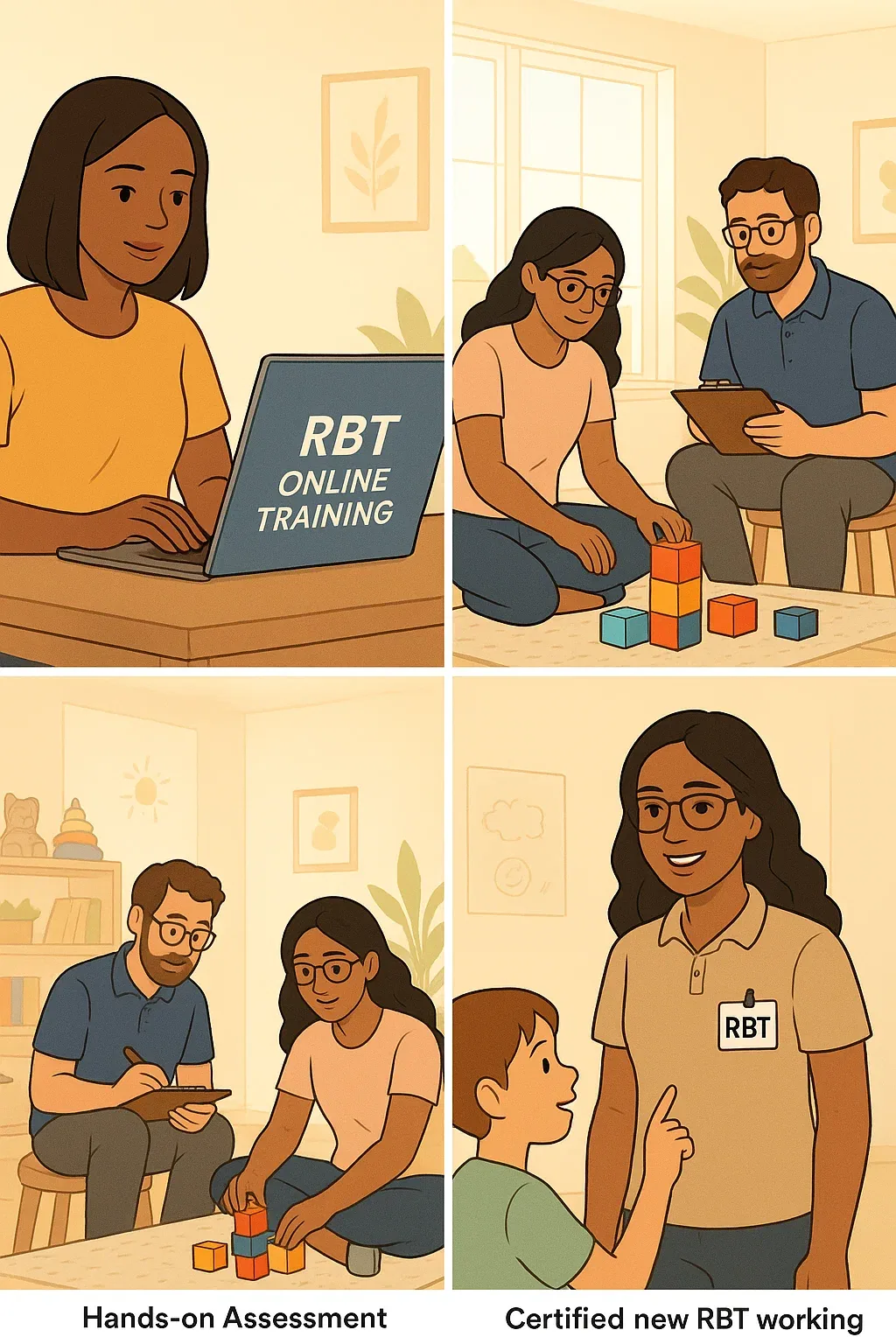
By this point, you must have completed the 40-hour RBT training.
The training was the foundational knowledge of applied behavior analysis (ABA): terms, techniques, and ethical guidelines.
That was your classroom learning.
The RBT Competency Assessment is the next step. It’s not a written test.
It’s a hands-on evaluation, where a qualified assessor (or an assistant assessor holding RBT certification or higher) observes you in action to confirm you can apply what you learned during training.
You’ll be asked to demonstrate real skills, like taking data, running teaching procedures, or responding to challenging behaviors.
Think of it as the “driving test” after finishing driver’s ed. You’ve learned the rules, now it’s time to show you can drive.
This RBT initial competency assessment makes sure that you’re not just familiar with behavior analysis terms; you can actually use them with clients.
It’s essential for protecting clients and ensuring you’re truly ready to work as an RBT under supervision.
The 2014 version of the RBT Competency Assessment looked different.
It had 37 tasks in six lettered sections, A-01 to F-05, running from Measurement to Professional Conduct and Scope of Practice.
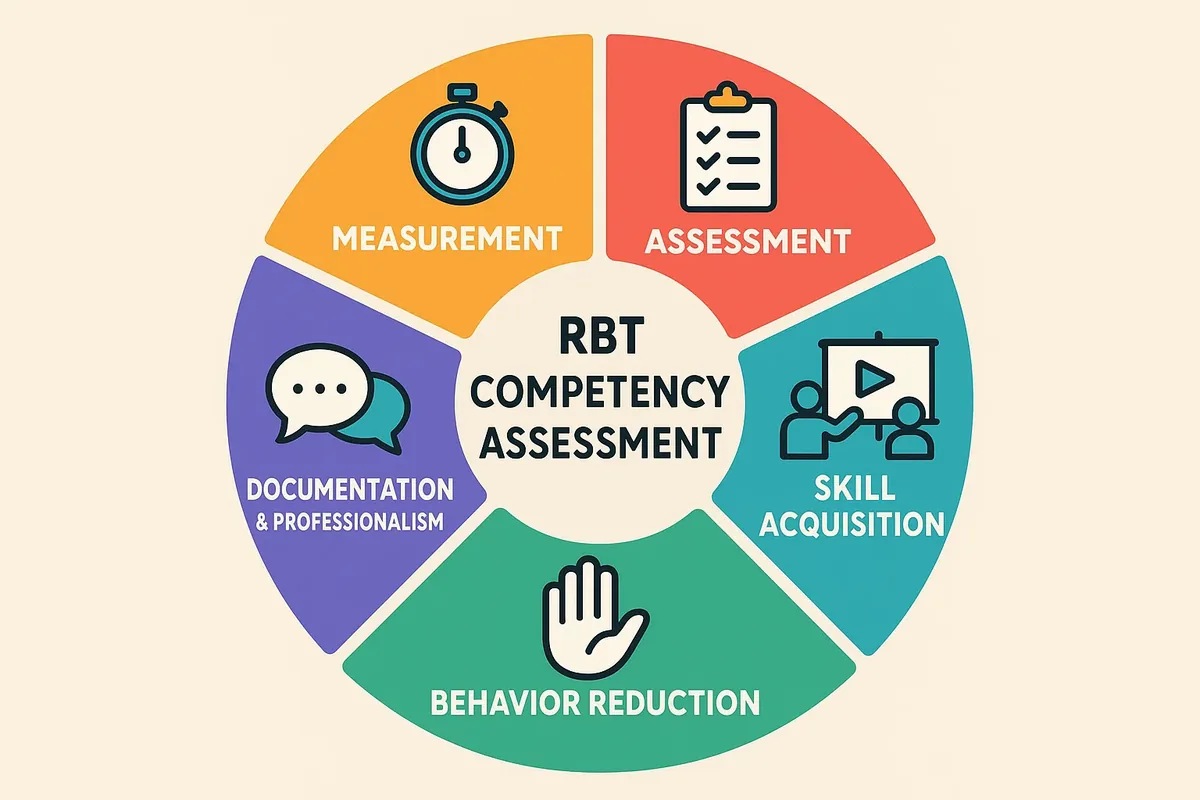
Now, with the packet that took effect on January 1, 2026, the BACB uses a 19-task format grouped into four sections: Measurement (tasks 1 to 3), Assessment (4 to 5), Skill Acquisition and Behavior Reduction (6 to 14), and Professionalism and Requirements (15 to 19). At least three of tasks 6 to 14 must be demonstrated with a real client; the others can be shown with a client, in role-play, or, for a few, in an interview. Source: RBT Initial Competency Assessment packet, effective January 1, 2026.
| # | Task (our summary) | How it can be assessed |
| 1 | Continuous measurement (frequency, duration, latency, IRT) | Client or role-play |
| 2 | Discontinuous measurement (partial/whole interval, momentary time sampling) | Client or role-play |
| 3 | Enter data and update graphs | Client or role-play |
| 4 | Conduct preference assessments | Client or role-play |
| 5 | Collect ABC data | Client or role-play |
| 6 | Discrete-trial teaching | Client or role-play |
| 7 | Naturalistic teaching (e.g., incidental teaching) | Client or role-play |
| 8 | Task-analyzed chaining | Client or role-play |
| 9 | Shaping | Client or role-play |
| 10 | Discrimination training | Client or role-play |
| 11 | Prompting and prompt fading | Client or role-play |
| 12 | Token systems | Client or role-play |
| 13 | Crisis/emergency procedures per protocol | Client, role-play or interview |
| 14 | One of: antecedent interventions, differential reinforcement (DRA, DRO), or extinction | Client or role-play |
| 15 | Objective session notes | Client, role-play or interview |
| 16 | Maintaining client dignity (examples) | Interview |
| 17 | Maintaining professional boundaries (examples) | Interview |
| 18 | Describe BACB supervision standards for RBTs | Interview |
| 19 | Describe a situation where you would seek clinical direction | Interview |
Your assessor initials each task once you perform it competently and marks which assessment type was used.
Domains Covered in RBT Competency Assessment
The RBT Competency Assessment tests your ability to perform practical, real-life tasks across the four sections of the 2026 packet: measurement, assessment, skill acquisition and behavior reduction, and professionalism.
The four sections of the 2026 assessment
The 2026 packet groups the 19 tasks into the same four sections the 02/2023 packet used. That version had 20 tasks, and the 2026 packet drops the stimulus control transfer task. The lettered A-01 to F-05 numbering belongs to the 2014 version.
Measurement (tasks 1 to 3)
Implement continuous measurement (frequency, duration, latency, interresponse time), implement discontinuous measurement (partial and whole interval, momentary time sampling), and enter data and update graphs.
Example: you might be asked to record how often a child raises a hand during a session while also running a teaching program.
Assessment (tasks 4 to 5)
Conduct a preference assessment (multiple stimulus, paired stimulus or free operant) and collect ABC data.
Example: you run a quick preference assessment to find out which toy motivates the client before starting a teaching activity.
Skill Acquisition and Behavior Reduction (tasks 6 to 14)
The largest section, and the only one with a client requirement: at least three of these nine tasks must be demonstrated with a real client, not in role-play. The tasks are discrete-trial teaching, naturalistic teaching, task-analyzed chaining, shaping, discrimination training, prompting with fading, token systems, crisis and emergency procedures, and one of antecedent interventions, differential reinforcement or extinction.
Example: you teach a client to identify colors using discrete-trial teaching, prompt correctly, deliver reinforcement, and fade the prompt.
Professionalism and Requirements (tasks 15 to 19)
Generate objective session notes, give examples of maintaining client dignity, give examples of maintaining professional boundaries, describe the BACB supervision standards for RBTs, and describe a situation in which you would seek clinical direction. Tasks 16 to 19 are assessed by interview.
Example: your assessor asks how you would respond if a parent offered you a gift, and what you would tell your supervisor.
Study Materials for RBT Exam (e.g., Quizlet, practice tests)
Here’s a comprehensive guide to the most effective and up-to-date study materials for preparing for the RBT Competency Assessment:
Official BACB Resources
- Primary Materials
- RBT Test Content Outline (3rd Edition)
- RBT Initial Competency Assessment packet (effective January 1, 2026)
- BACB RBT Handbook
- BACB 40-Hour Training Requirements and Curriculum Outline
- Digital Study Platforms
Want to rehearse the skills behind the assessment before your assessor watches you? These free practice sets cover the same ground:
- Behavior Acquisition quiz for prompting, chaining, DTT and reinforcement
- Behavior Reduction quiz for extinction, differential reinforcement and crisis plans
- Data Collection quiz for the measurement tasks
- RBT study guide, task by task on the 3rd-edition outline
- Printable RBT practice test PDF if you like practicing on paper
- Online Practice Platforms
- Recommended Study Books
- “Cooper, Heron, and Heward’s Applied Behavior Analysis (3rd Edition)” – The foundational textbook for ABA principles
- “RBT Study Guide 2026-2027” by Newstone Test Prep – Targeted preparation material
5. Mobile Apps and Tools
- RBT Exam Center – Prep & Study: Practice RBT questions with explanations
- Behavior Tracker Apps: For practicing data collection skills
Tips for a Successful Competency Assessment
A successful RBT Competency Assessment requires not only technical knowledge, but also strong presentation, adaptability, and confidence under observation. Here’s how to prepare and perform at your best.
Pre-Assessment Preparation
1. Master the Fundamentals
Carefully go through all 19 tasks in the RBT initial competency assessment so you truly understand them, not just memorize.
Practice taking data every day, like how often a behavior happens (frequency), how long it lasts (duration), how long it takes to start (latency), and interval recording.
Learn the key terms and steps from the 2026 competency assessment packet using rbt competency assessment quizlet resources so you feel confident and prepared when it’s time to use them.
2. Hands-On Practice
Practice is key. Try doing mock RBT competency assessments with a certified RBT or BCBA to get feedback. If you can, work directly with clients under supervision to build real-world experience.
Recording yourself while performing procedures can help you spot mistakes and improve your fluency.
You can also role-play RBT competency assessment practice tests with peers to practice handling different situations and improve how quickly and accurately you respond.
3. Sharpen Documentation Skills
Improve your documentation by practicing clear, objective, and timely data recording. Learn how to graph behavior trends and make sense of what the data shows.
Make sure you understand HIPAA rules and your workplace’s confidentiality policies. Finally, get comfortable writing session notes that clearly describe the behavior you observed, the strategies you used, and the results.
During the Assessment
1. Professional Presentation
Arrive early and bring everything you need: data sheets, reinforcers, timers, and any other tools required. Dress neatly and act professionally at all times.
Speak clearly and respectfully with both the client and the assessor. Your confidence, preparation, and positive attitude will stand out.
2. Technical Execution
Stick to what you were trained to do; don’t try to make things up during the assessment. Collect data accurately as things happen, not afterward.
Follow prompting steps exactly, and use proper error correction methods. Show that you can handle behavior safely and ethically.
3. Problem-Solving & Adaptability
If something’s unclear, ask for clarification instead of guessing.
Stay calm if the client’s behavior doesn’t go as planned; adjust your approach while keeping the plan consistent.
And above all, always prioritize safety. It’s not optional.
| Challenge | Solution |
| Data collection while teaching | Practice multitasking with increasing complexity. Start simple and work your way up. |
| Client non-compliance | Use a toolbox of motivational strategies and maintain a calm, assertive demeanor. |
| Technical difficulties (for remote assessments) | Test your tech ahead of time. Have backup internet, devices, and contact info ready. |
You’ve learned the strategies; now it’s time to practice them. Take our free RBT practice test to identify your strengths and pinpoint areas that need more focus before your actual assessment.
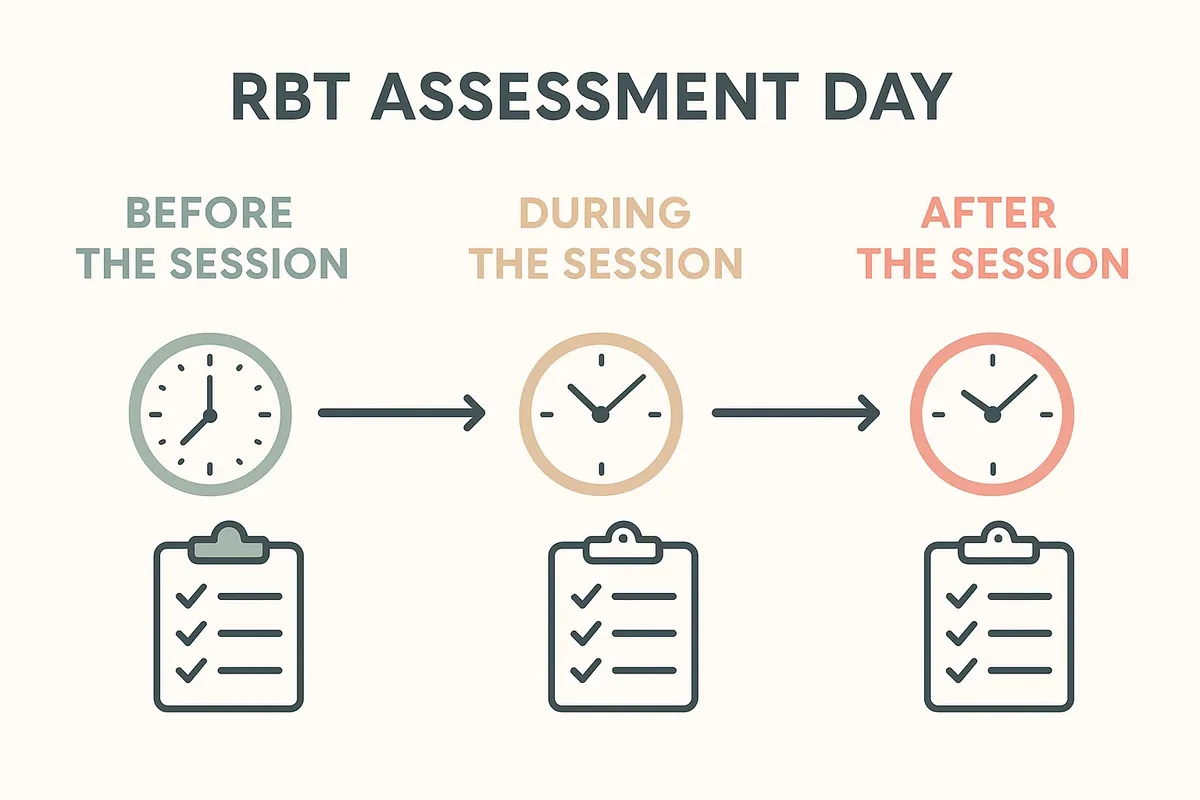
Assessment Day Timeline
Before the Session (30–60 minutes)
Review the client’s programs, data collection methods, and gather all necessary materials. Set up your workspace to avoid distractions. Take a moment to refresh your knowledge of emergency procedures and safety protocols.
During the Session
Perform the 19 tasks while being observed. Collect accurate data and interact with the client according to the plan. Afterward, engage in feedback and discussion with your assessor to understand your performance.
After the Session
Upload your completed RBT Initial Competency Assessment with your application without delay, since it can’t be completed more than 90 days before you apply. If the assessor recommends more practice, schedule a follow-up session.
Next Steps After Completing the Competency Assessment
Immediate Post-Assessment Actions
Once you finish the RBT competency assessment, you upload the completed, signed form with your RBT certification application. Your responsible assessor must be a BCBA or BCaBA. Make sure all required signatures and dates are included. Keep copies of these documents for your own records.
Application Processing
The BACB asks you to allow about two weeks to process your application, including the competency assessment. During this period, watch your email and your BACB portal account for updates. Be prepared to answer any follow-up questions from the BACB if needed.
Upon Certification
- Credential Maintenance: RBTs who recertify in 2026 complete the RBT Recertification Competency Assessment one last time and then move to a two-year cycle; RBTs first certified in 2026 receive a two-year certification. In each two-year cycle you earn 12 professional development units (PDUs), counted from the day the cycle starts, and recertifications from 2028 on need no competency assessment. The recertification fee is $50.
- Supervision: Once you’re certified, get ongoing supervision for at least 5% of the hours you provide services each calendar month. That includes at least two face-to-face, real-time contacts a month, at least one of them individual, and your supervisor must observe you providing services in at least one.
Professional Development Opportunities
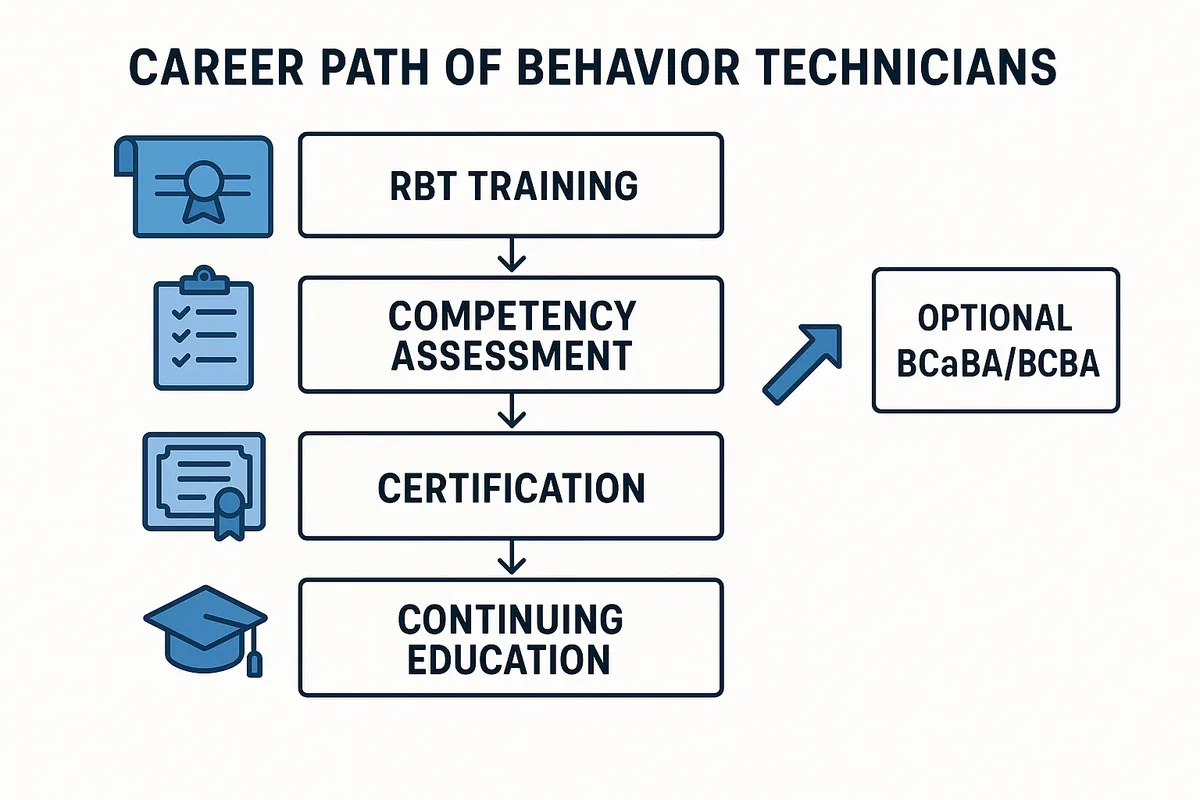
After certification, consider specialized training in areas like autism or developmental disabilities.
You can also pursue advanced certifications such as BCaBA or join professional organizations like the Association for Behavior Analysis International (ABAI) or your state’s ABA chapter.
Career Advancement Pathways
- Short-term: Seek senior RBT roles with added responsibilities or take on mentoring new RBTs. Specializing in certain populations can also open new opportunities.
- Long-term: Many RBTs aim to earn a bachelor’s degree to become eligible for BCaBA certification, or pursue a master’s degree to follow the BCBA pathway. Exploring related fields like special education or occupational therapy is another option.
Conclusion
Your RBT journey doesn’t end with passing the RBT competency assessment; it begins there.
Think about it. Every behavior analyst who’s making a difference today once sat exactly where you’re sitting right now.
Nervous. Excited. Ready to change lives but not quite sure they’re ready for the challenge.
The RBT initial competency assessment isn’t designed to trip you up. It’s designed to make sure you’re prepared for the incredible responsibility that comes with this role.
Because when you’re working with a child who’s been struggling to communicate, or helping a family find hope again, you’ll be grateful for every hour you spent preparing with RBT competency assessment quizlet resources and RBT competency assessment practice test materials.
So take a deep breath. Study smart, not just hard. Practice with purpose. And remember, you’re not just working toward a certification.
You’re working toward a career that will challenge you, fulfill you, and give you the chance to make a real difference in the world.
The field of behavior analysis needs passionate, well-prepared professionals like you.
Before you walk into that assessment room, make sure you’re truly ready.
Our free RBT practice test can help you identify your weak spots and build the confidence you need to pass on your first attempt.
Don’t let fear hold you back.