
If you’re preparing for the RBT exam and feeling overwhelmed by the amount of material you need to master, you’re at the right place.
The Registered Behavior Technician certification exam covers six complex domains, and without a structured approach, many candidates struggle to organize their study time effectively.
This comprehensive RBT exam study plan is specifically designed to help you build a systematic, and confidence-building process.
Whether you’re a first-time test-taker or retaking the exam, this 4-week schedule breaks down every concept you need to know into manageable daily sessions.
Want the content itself before you plan the weeks? Our free RBT exam study guide covers all 43 tasks on the 3rd-edition outline, area by area.
Let’s dive in.
Understand What An RBT Exam Is
The RBT exam consists of 85 multiple-choice questions that you must complete in 90 minutes. That’s about one minute per question.
Here’s what makes this challenging: 10 of those questions are unscored pilot questions, but you won’t know which ones they are. This means you must treat every single question seriously.
The exam covers six content areas from the BACB’s RBT Test Content Outline (3rd Edition), in force since January 1, 2026.

- Your primary goal should be scoring 85% or higher on practice exams consistently. That’s our own benchmark, not a BACB cut-off. The BACB sets the passing score with a panel of experts (the modified Angoff method).
- Your secondary goal is building automatic recall of the outline’s tasks under pressure.
- Your hidden goal (the one that separates passing candidates from failing ones) is developing scenario-based thinking patterns that match the exam’s logic.
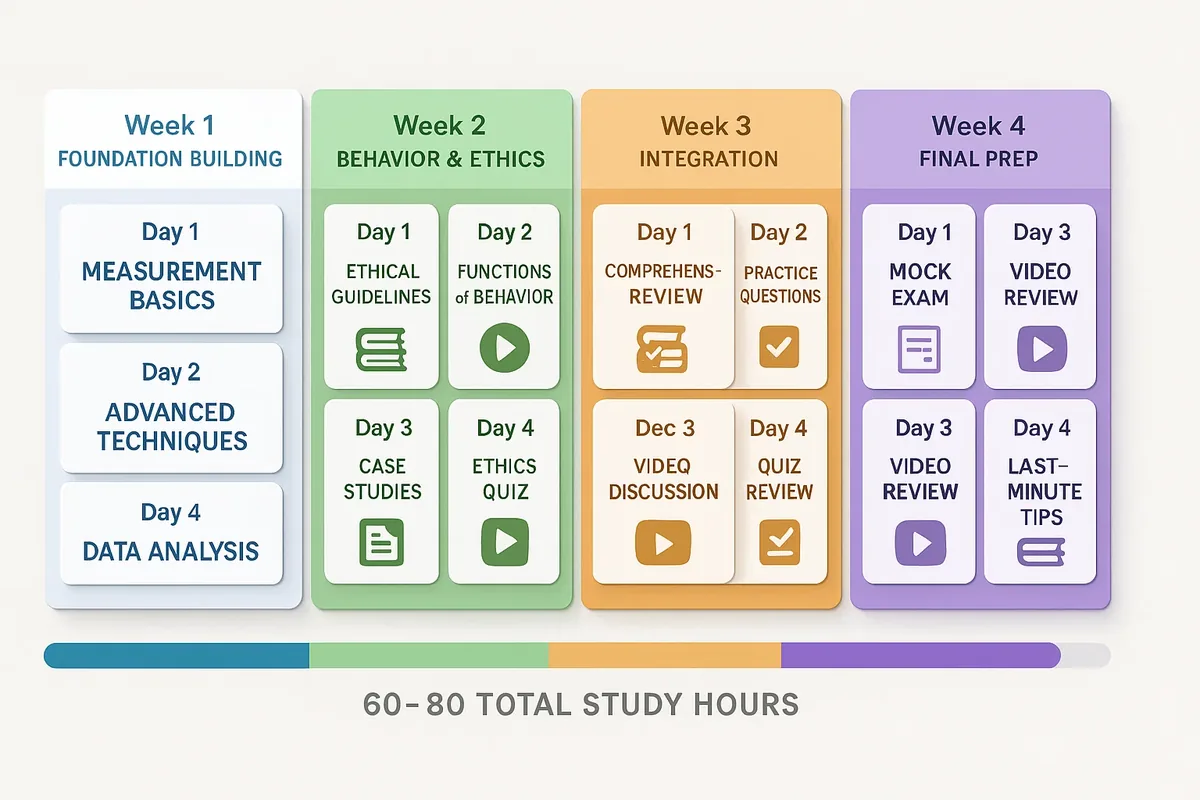
Plan for roughly 70 to 100 hours of total study time when following a structured rbt exam study plan. This breaks down to 2-3 hours on weekdays and 4-5 hours on weekends. Identify your peak focus windows, usually 2-3 periods of 90 minutes each day when your concentration is strongest.
Plan for setbacks by budgeting 20% extra time in your rbt exam study plan. You will get stuck on measurement concepts. Ethics scenarios will confuse you initially. You’ll need to re-learn things you thought you already knew. This is normal and expected.
Week 1 of RBT Exam Study Plan
In Week 1 of your RBT exam study plan, your goal is to build a strong foundation. The RBT exam is based on the BACB Test Content Outline (3rd Edition), so understanding every one of its 43 tasks is crucial.
MONDAY – Data Collection and Graphing (Section A)
You’ll begin by understanding what measurement means in ABA, and why it’s a critical foundation for everything that follows.
On Day 1, your focus will be on mastering the four core measurement concepts: Frequency, Duration, Latency, and Inter-Response Time (IRT)
Day 1 Action Plan:
- Read Content Area A (Data Collection and Graphing) (30 minutes)
- Watch “Measurement Explained” on ABA Exam Academy YouTube (20 minutes)
- Create flashcards for each measurement type (15 minutes)
- Quiz yourself immediately (25 minutes)
- Practice identifying measurement types with real scenarios
- Take Free Measurement Practice Test
Monday Checklist:
- Understand all 4 basic measurement types
- Can give real-world example for each
- Scored 70%+ on practice quiz
- Created 20 measurement flashcards
TUESDAY – Advanced Measurement Techniques
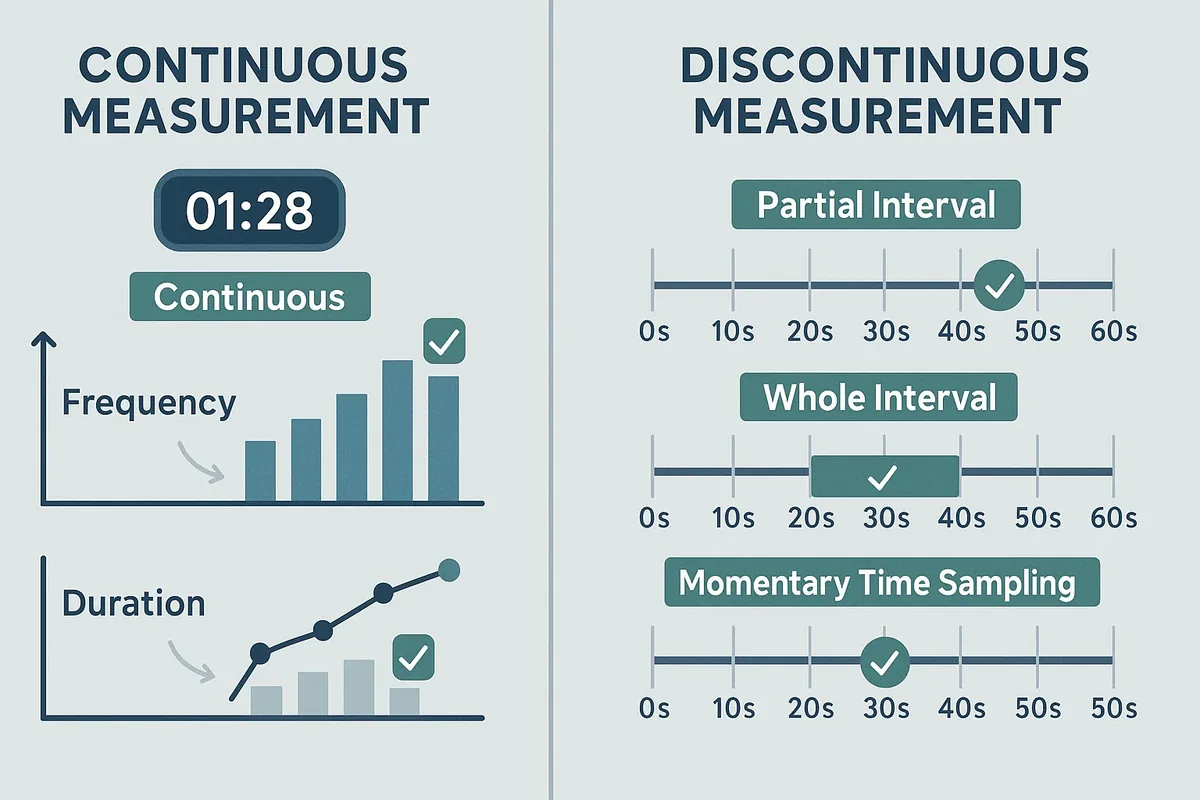
Today’s focus in your RBT exam study plan is on mastering the three types of discontinuous measurement:
- Partial Interval Recording
- Whole Interval Recording
- Momentary Time Sampling
Look up a video on YouTube that walks through real-life examples of each method. Search:
“RBT Discontinuous Measurement Examples” – pause, take notes, and replay if needed.
Action Plan for Day 2:
- Draw timeline examples in your notebook (45 minutes)
- Practice with 3 different scenarios (30 minutes)
- Use Anki for spaced repetition (15 minutes)
- Take scenario-based quiz (30 minutes)
Tuesday Checklist:
- Can explain when to use each recording method
- Understand over/underestimation patterns
- Practiced with timeline drawings
- Scored 75%+ on advanced measurement quiz
WEDNESDAY – Assessment Strategies (Section B)
Today, you’re digging into Content Area B of the Test Content Outline, which covers how to assist with behavior assessment. You’ll focus on:
- Running preference assessments
- Understanding direct vs indirect assessments
- Practicing ABC data collection
Assessments help you figure out what motivates the client, what skills they have (or don’t), and how to shape behavior change that sticks.
Action Steps For Day 3:
- Read Content Area B (Behavior Assessment) thoroughly (40 minutes)
- Watch “Preference Assessment Demo” on Hopebridge ABA YouTube (20 minutes)
- Practice ABC data collection with 3 mock scenarios (45 minutes)
- Create visual comparison chart: Direct vs Indirect assessment (15 minutes)
- Give Free Assessment Practice Test
Wednesday Checklist:
- Can run each type of preference assessment
- Understand direct vs indirect assessment
- Completed 3 ABC data examples
- Created assessment comparison chart
THURSDAY – Behavior Acquisition Part 1 (Section C)
Today is all about the how: how we actually teach clients new behaviors and skills using two core ABA methods that are essential in every rbt exam study plan:
- Discrete Trial Teaching (DTT)
- Natural Environment Teaching (NET)
You’ll also learn how to prompt effectively using a hierarchy, from full support to independence.
Action Steps For Day 4:
- Study Content Area C (Behavior Acquisition) (45 minutes)
- Watch DTT and NET demos on Autism Helper YouTube (30 minutes)
- Create prompting hierarchy flashcards (20 minutes)
- Practice identifying teaching opportunities (25 minutes)
- Give Free Skill Acquisition Practice Test
Thursday Checklist:
- Can explain DTT vs NET differences
- Understand prompting hierarchy
- Know when to use each teaching method
- Created teaching strategy flashcards
FRIDAY – Skill Acquisition Part 2
On Day 5 of your rbt exam study plan, you’ll study how to break down skills, reinforce progress, and fade support over time. Here’s what you’re learning today:
- Shaping
- Chaining
- Prompt Fading Strategies
Action Steps For Day 5:
- Sketch shaping and chaining examples (30 minutes)
- Create real-world scenarios for each strategy (45 minutes)
- Practice prompt fading sequences (30 minutes)
- Take 15-question skill acquisition quiz on FreeRBTPracticeTest (15 minutes)
Friday Checklist:
- Can design shaping program
- Understand forward vs backward chaining
- Know all prompt fading methods
- Scored 80%+ on skill acquisition quiz
WEEKEND: Week 1 Review
On the weekend, you’re going to actively engage with everything you’ve learned so far in Sections A-C: Data Collection and Graphing, Behavior Assessment, and Behavior Acquisition.
- Morning (2 hours): Review all flashcards from Sections A-C. Rewatch one key video per section. Take a 25-question mixed quiz on ABA Rocks.
- Afternoon (1 hour): Create a mind map connecting all Week 1 concepts. Example: Measurement → Assessment → Teaching strategies.
- Evening (30 minutes): Light review while walking or exercising.
Week 2 of RBT Exam Study Plan
Goal: Master behavior interventions, documentation, and ethics
MONDAY – Understanding Problem Behavior (Section D.1)
Today, you’re diving into one of the most critical concepts in ABA: understanding why problem behaviors occur. If you memorize anything this week in your rbt exam study plan, make it SEAT, the 4 functions of behavior:
- Sensory: Automatic, self-stimulating (e.g., hand-flapping)
- Escape: Avoiding something undesirable (e.g., tantrum to skip tasks)
- Attention: Seeking interaction (positive or negative)
- Tangible: Getting a specific item or activity (e.g., crying for a toy)
You’ll also study antecedent strategies: what you can do before a behavior occurs to stop it from even starting.
Action Steps For Day 1:
- Study Content Area D (Behavior Reduction) thoroughly (45 minutes)
- Watch “Behavior Functions Explained” on ABA Study Guide YouTube (25 minutes)
- Practice ABC data collection with function identification (40 minutes)
- Create SEAT memory device flashcards (10 minutes)
- Give Free Behavior Reduction Practice Test
Monday Checklist:
- Can identify all 4 behavior functions
- Understand antecedent vs consequence strategies
- Practiced function identification with 5 scenarios
- Created behavior function flashcards
TUESDAY – Behavior Reduction Procedures
Today, you’re learning how to replace disruptive behavior with constructive alternatives, how to stop reinforcing what you don’t want, and how to stay safe when things escalate. Your rbt exam study plan must include mastery of these 4 techniques:
- DRA (Alternative Behavior)
- DRO (Other Behavior)
- DRI (Incompatible Behavior)
- DRL (Low Rates of Behavior)
Action Steps For Day 2:
- Write examples of DRA, DRO, DRI for same behavior (45 minutes)
- Create “What would you do?” scenarios (30 minutes)
- Study crisis/emergency procedures, TCO task D.7 (30 minutes)
- Practice identifying differential reinforcement types (15 minutes)
Tuesday Checklist:
- Can design DRA, DRO, DRI, DRL programs
- Understand extinction procedures and risks
- Know crisis management protocol
- Created differential reinforcement examples
WEDNESDAY – Documentation Excellence (Section E)
By the end of today’s rbt exam study plan session, you’ll know how to write clean, professional, legally sound notes that protect everyone involved, and reflect the gold-standard in ethical ABA practice. You’ll master:
- The difference between objective and subjective language
- What makes a session note complete and objective
- How to write rock-solid session notes
- What’s outside your role as an RBT
- Real-world practice scenarios
Action Steps For Day 3:
- Study Content Area E (Documentation and Reporting) (30 minutes)
- Watch documentation video breakdown (20 minutes)
- Practice rewriting 5 subjective statements objectively (40 minutes)
- Review HIPAA basics for RBTs (20 minutes)
- Take Free documentation quiz (10 minutes)
Wednesday Checklist:
- Can distinguish objective from subjective reporting
- Know all RBT documentation requirements
- Practiced rewriting subjective statements
- Understand confidentiality rules
THURSDAY – Ethics (Section F)
Today, you build the ethical backbone of your career as part of your comprehensive rbt exam study plan. What we’re doing today:
- Learning the Core Ethical Principles
- Studying Real-World Scenarios
- Understanding Supervision Requirements
- Clarifying Your Professional Limits
Action Steps For Day 4:
- Read RBT Ethics Code completely (45 minutes)
- Watch real-world ethics scenarios on ABA Academy YouTube (30 minutes)
- Write responses to 5 ethical dilemmas (30 minutes)
- Take the Free Ethics Quiz (15 minutes)
Thursday Checklist:
- Know core ethical principles
- Can respond appropriately to ethical dilemmas
- Understand supervision requirements
- Scored 90%+ on ethics quiz
FRIDAY – Week 2 Integration
Today is about connecting the dots between behavior reduction, documentation, and ethics in your rbt exam study plan. You’re practicing the five key actions today which every great RBT repeats daily:
- Observe behavior objectively
- Collect accurate data
- Implement supervisor-designed interventions
- Document everything professionally
- Communicate with team ethically
Action Steps For Day 5:
- Review all Week 2 flashcards (45 minutes)
- Complete mixed quiz focusing on D-F topics (30 minutes)
- Connect concepts with real-life client examples (30 minutes)
- Create “Ethics Red Flag” checklist (15 minutes)
Friday Checklist:
- Connected behavior reduction to documentation
- Understand professional workflow
- Created comprehensive ethics guide
- Ready for Week 2 assessment
WEEKEND: Week 2 Assessment
On Saturday: Take a 50-question mock exam (Sections D–F), aim for 75–80%, and review all incorrect answers in depth. Run flashcard drills on behavior functions and differential reinforcement, practice objective vs subjective writing, and revisit key ethics scenarios
On Sunday: Do a full flashcard review (Sections A–F), watch videos for any weak areas, and update notes with new takeaways. Reflect in a study journal: list 3 concepts mastered, 3 to revisit, and plan Week 3 focus using mock exam data and self-assessment
Week 3 of RBT Exam Study Plan
Goal: Connect all concepts and develop exam-level confidence through your rbt exam study plan.
MONDAY – Cross-Domain Integration
Today is about learning how to think like a real RBT by integrating all the core domains. data collection, behavior assessment, behavior acquisition, behavior reduction, documentation and ethics, into a cohesive workflow.
Action Steps For Day 1:
- Take 50-question mixed quiz covering all domains (60 minutes)
- Analyze performance by section (15 minutes)
- Create integration mind map showing connections (30 minutes)
- Review flashcards for weakest areas (15 minutes)
Monday Checklist:
- Completed comprehensive mixed quiz
- Identified cross-domain connections
- Created integration study materials
- Performance tracking updated
TUESDAY – Ethics Deep Dive & Real-World Application
Today is about strengthening your ability to apply ethical principles in real-life, high-pressure situations, a crucial aspect of any rbt exam study plan.
Action Steps For Day 2:
- Work through 10 complex ethical scenarios (60 minutes)
- Create “Ethics Red Flag” checklist (20 minutes)
- Practice ethical decision-making framework (30 minutes)
- Review professional boundary guidelines (10 minutes)
Tuesday Checklist:
- Can navigate complex ethical scenarios
- Understand professional boundary guidelines
- Created comprehensive ethics reference
- Practiced ethical decision-making process
WEDNESDAY – Supervision & RBT Role Clarity
You’ll gain clarity on your scope of practice, the importance of supervision, and what falls under your professional responsibilities. Here are the supervision essentials that every rbt exam study plan should cover:
5% Rule: You need supervision for at least 5% of your monthly service hours
- 20 hours of service = 1 hour supervision minimum
- 40 hours of service = 2 hours supervision minimum
Action Steps For Day 3:
- Review RBT Handbook supervision section (30 minutes)
- Practice role-play: What to report vs. what not to report (45 minutes)
- Create supervision meeting preparation checklist (15 minutes)
- Take RBT scope of practice quiz on FreeRBTPracticeTest (20 minutes)
Wednesday Checklist:
- Clear on RBT role boundaries
- Understand supervision requirements
- Know what to report to supervisor
- Created supervision reference guide
THURSDAY – Data Collection Mastery
Today is all about mastering data collection, the foundation of effective ABA therapy and a critical component of your rbt exam study plan. You’ll dive into key methods like frequency, duration, interval recording, and ABC data.
Action Steps For Day 4:
- Practice with sample data sheets from Hopebridge (45 minutes)
- Watch data collection videos and take notes (30 minutes)
- Role-play data collection scenarios (30 minutes)
- Create data collection troubleshooting guide (15 minutes)
Thursday Checklist:
- Comfortable with all data collection methods
- Can troubleshoot common data problems
- Practiced with realistic data sheets
- Created personal data collection guide
FRIDAY – Full Mock Exam Challenge
Today is your full mock exam challenge. This is your chance to test everything you’ve learned across all domains under timed conditions.
Want to rehearse on paper too? Print our free RBT practice test PDF: 75 questions weighted like the real exam, with an answer key.
Action Steps For Day 5:
- Take 85-question timed mock exam (90 minutes)
- Score and analyze performance (30 minutes)
- Identify top 3 focus areas for Week 4 (15 minutes)
- No additional studying today – rest and reflect
Friday Checklist:
- Completed full-length mock exam
- Analyzed performance thoroughly
- Identified Week 4 priorities
- Maintained positive mindset
WEEKEND: Week 3 Mastery Check
- On Saturday: Focus 2 hours on the weakest section identified in your rbt exam study plan progress. Take a 25-question targeted quiz. Review missed concepts immediately. Update flashcards with new insights.
- On Sunday: Complete flashcard review of all sections. Create a visual mind map of all six content areas. Practice teaching concepts out loud. Take final 25-question mixed quiz
Week 4 of RBT Exam Study Plan
The final week of your rbt exam study plan focuses on targeted review and maintaining peak mental condition.
Monday – Targeted Weakness Review
Use your Week 3 mock exam to identify your weakest domain. Focus only on that area with quick drills and real-world examples. Don’t spread your attention; go deep on one weakness.
Tuesday – Speed & Accuracy Training
Do a 30-minute timed session: 30 questions, 1 minute each. Then review what you flagged. Train your brain to spot keywords like “first,” “immediately,” or “supervisor says.” The goal is fast, confident decisions.
Wednesday – Confidence Building
Keep it light: flip flashcards, take a short quiz, watch a recap video. Then close your eyes and visualize exam success, calm, focused, and in control.
Thursday – Final Systems Check
Take one last full mock exam under test conditions. If you score 85%+ (our benchmark), you’re ready. If you’re under 80%, consider a one-week delay. Prep your ID, test day plan, and rest well.
Friday – Rest & Recharge
No studying. Just light exercise, good food, and calm activities. Go to bed early and protect your mental energy.
Exam Day Strategy
Arrive early. Read carefully. Trust your prep. Use time wisely. Remember, you’ve followed a comprehensive rbt exam study plan designed for success.
Conclusion
You came here searching for a solid RBT exam study plan, and now, you’ve got one.
This is a clear, step-by-step roadmap that tells you exactly what to study each day. No more guessing. No more overwhelm.
Here’s what this plan gives you:
- A 4-week schedule that breaks down every topic based on how much it matters on the exam
- Built-in quizzes and mock exams to get you used to the real test format
- Daily action steps so you always know what to focus on
- Extra time built in for review, rest, and when life gets busy
Follow the plan, trust the process, and in just four weeks, you’ll be walking into your exam with confidence.




One Comment
Comments are closed.