
RBT Study Guide 2026: Free Resource for the RBT Test Content Outline (3rd Edition)

The path to becoming a Registered Behavior Technician (RBT) starts with mastering the knowledge and skills outlined in the BACB’s RBT Test Content Outline (3rd Edition). This RBT Study Guide serves as your central hub for exam preparation, offering a clear and structured overview of the six content areas every aspiring RBT must understand. Whether you’re beginning your training or revisiting key areas before your exam, this guide will help you build a strong foundation in essential ABA terminology and practices.
Each content area in the outline covers a critical area of applied behavior analysis. From measuring behavior to reducing it, and from conducting assessments to maintaining ethical standards, this guide breaks down each task into digestible summaries.
These serve as previews to in-depth domain pages where you can explore the concepts thoroughly as you move forward with your RBT exam preparation. Want a day-by-day schedule for working through it? Follow our 4-week RBT study plan.
Ready to test your knowledge? Try our Free RBT Practice Test to apply what you’re learning across all domains.
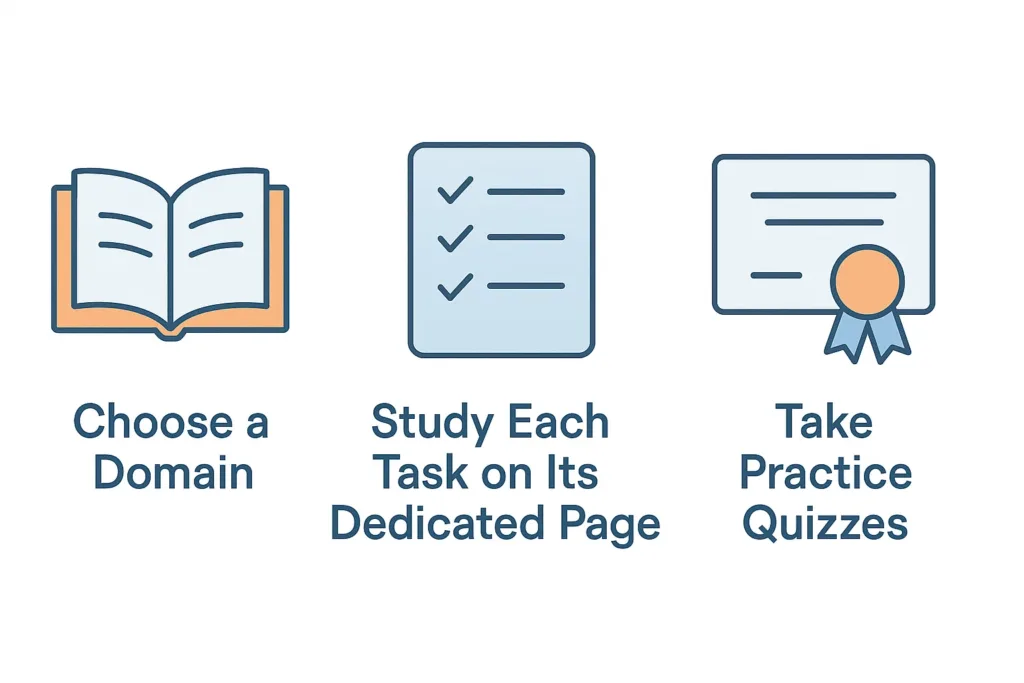
Use the guide below to structure your Registered Behavior Technician exam preparation step by step.
Table of Contents

A. Data Collection and Graphing (formerly Measurement)
Updated September 2026. The RBT exam has followed the RBT Test Content Outline (3rd Edition) since January 1, 2026: 43 tasks in six content areas, 75 scored questions plus 10 unscored pilot items, 90 minutes. Four areas were renamed and the task numbering changed from hyphens (A-1) to dots (A.1). The table maps each area to its full guide. Below it, you’ll find all 43 tasks with a short summary of each. For definitions of the terms these tasks use, see our RBT Exam Glossary (3rd Edition).
| 3rd Edition area | 2nd Edition name | Scored questions | Tasks | Guide |
| A. Data Collection and Graphing | Measurement | 13 (17%) | 8 (A.1 to A.8) | Data Collection and Graphing guide |
| B. Behavior Assessment | Assessment | 8 (11%) | 3 (B.1 to B.3) | Behavior Assessment guide |
| C. Behavior Acquisition | Skill Acquisition | 19 (25%) | 11 (C.1 to C.11) | Behavior Acquisition guide |
| D. Behavior Reduction | Behavior Reduction | 14 (19%) | 7 (D.1 to D.7) | Behavior Reduction guide |
| E. Documentation and Reporting | Documentation and Reporting | 10 (13%) | 4 (E.1 to E.4) | Documentation and Reporting guide |
| F. Ethics | Professional Conduct and Scope of Practice | 11 (15%) | 10 (F.1 to F.10) | Ethics guide |
A.1 Implement continuous measurement procedures
Continuous measurement means you record every single instance of the behavior during the observation. Frequency, duration, latency and interresponse time all live here. It’s the most complete picture you can get, so it’s the default whenever you can watch the whole time.
A.2 Implement discontinuous measurement procedures
Here you record a sample instead of every instance. You split the session into intervals and score each one by a rule: partial interval, whole interval or momentary time sampling. Handy when a behavior is too fast or too fuzzy to count one by one.
A.3 Implement permanent product recording
You measure the result a behavior leaves behind, not the behavior itself. Think completed worksheet problems or folded towels. No need to watch every second; you count the product afterward.
A.4 Enter data and update graphs
Your data sheet is only half the job. You also enter the data accurately and keep the graph current, so your supervisor can see what’s changing from one session to the next.
A.5 Describe behavior and environment in observable and measurable terms
Before you can count a behavior, it needs a clear operational definition. Describe what it looks like, not what you think the client feels. Two people watching the same session should score it the same way.
A.6 Calculate and summarize data
Raw tallies need one more step. The exam expects you to work out rate, mean duration and percentage. Quick example: 15 responses in 90 minutes is a rate of 10 per hour.
A.7 Identify trends in graphed data
You don’t make treatment decisions, but you’re expected to notice what a graph shows and report it. Look at three things: level, trend and variability.
A.8 Describe the risks of unreliable data collection and poor procedural fidelity
Bad data leads to bad decisions. Sloppy recording, or drifting away from the written procedure, can make a plan look like it’s working when it isn’t. Or the other way round.
Go deeper: read the full Data Collection and Graphing guide, then test yourself with the free Area A quiz.
B. Behavior Assessment (formerly Assessment)
B.1 Conduct preference assessments
A preference assessment finds the items and activities your client is likely to work for. You’ll run multiple stimulus, paired stimulus and free operant formats. One catch: a preferred item is only a potential reinforcer until it actually increases behavior.
B.2 Participate in assessments of skill strengths and deficits
You help map what a client can already do and what still needs teaching. The outline names curriculum-based, developmental and social skills assessments. Your part is to run your piece exactly as trained and record it accurately.
B.3 Participate in components of functional assessment
This one’s about why a behavior happens. Attention, escape, tangibles and automatic reinforcement are the usual suspects. You’ll help with descriptive assessment (like ABC data) and functional analysis sessions, always under your supervisor’s direction.
Go deeper: read the full Behavior Assessment guide, then test yourself with the free Area B quiz.

C. Behavior Acquisition (formerly Skill Acquisition)
C.1 Implement positive and negative reinforcement procedures
Reinforcement is any consequence that makes a behavior more likely in the future. Positive reinforcement adds something; negative reinforcement removes something. Deliver it immediately and contingently, on the right schedule, and vary it so it keeps working.
C.2 Establish and use conditioned reinforcers
Praise, tokens and points aren’t reinforcing on their own. They earn that power by being paired with things that already work, like a snack or a favorite toy. That pairing is your job.
C.3 Implement discrete-trial teaching procedures
Discrete-trial teaching breaks learning into short, repeated trials. Each one has an instruction (the SD), the client’s response, a consequence and a brief pause before the next trial. Structured. Fast. Easy to measure.
C.4 Implement naturalistic teaching procedures
Naturalistic teaching, which covers incidental teaching and natural environment training, builds learning into everyday play and routines. The client’s interest sets up the moment, and the reinforcer is usually the very thing they wanted.
C.5 Implement task-analyzed chaining procedures
Skills like hand washing are really chains of smaller steps. A task analysis lists those steps, and you teach them with forward, backward or total task chaining.
C.6 Implement discrimination training
Discrimination training teaches a client to respond to one stimulus and not to others. You reinforce the right response when the right cue is present and hold back reinforcement otherwise. It’s how “touch red” starts to mean red.
C.7 Implement stimulus and response prompts with fading
Prompts are extra help that make a correct response more likely. Response prompts act on the learner (physical, model, gesture, verbal), while stimulus prompts change the materials. The real skill is fading them before the client starts to depend on you, which is exactly what goes wrong in this prompt dependency exam question.
C.8 Implement generalization procedures
A skill isn’t learned until it shows up outside the session. Generalization means it happens across settings, people and materials you never directly taught.
C.9 Distinguish maintenance from acquisition procedures
Acquisition is learning something new. Maintenance is keeping a mastered skill going over time with less teaching. They’re run differently, so the exam wants you to tell them apart.
C.10 Implement shaping procedures
Use shaping when the target behavior doesn’t happen yet. You reinforce successive approximations, each one a little closer to the goal, and stop reinforcing the earlier versions as you go.
C.11 Implement token economy procedures
Clients earn tokens for target behaviors and trade them in for backup reinforcers. Tokens only work if they’ve been properly paired first, so C.2 and C.11 go hand in hand.
Go deeper: read the full Behavior Acquisition guide, then test yourself with the free Area C quiz.
D. Behavior Reduction
D.1 Identify common functions of behavior
Every behavior does something for the person. The four common functions are attention, escape, access to tangibles and automatic (sensory) reinforcement, and the plan you run is built around that function. Here’s a closer look at the 4 functions of behavior.
D.2 Implement antecedent interventions
Antecedent interventions change what happens before the behavior, so it’s less likely to start at all. The outline names noncontingent reinforcement, high-probability request sequences and demand fading.
D.3 Implement differential reinforcement procedures
You reinforce one behavior and withhold reinforcement for another. DRO, DRA, DRI, DRL and functional communication training are all on the outline, and our differential reinforcement guide walks through each one.
D.4 Implement extinction procedures
Extinction means withholding the reinforcer that’s been keeping a behavior going. What that looks like depends on the function, which is why it’s never just “ignore it”.
D.5 Implement positive and negative punishment procedures
Punishment is defined by its effect: a consequence that makes a behavior less likely in the future. Positive punishment adds something; negative punishment, like time-out, takes access away. You only use it when it’s in the written plan and your supervisor has checked your competence.
D.6 Describe the secondary effects of extinction and punishment
Both come with side effects. Extinction can bring bursts, response variation, resurgence and emotional responding; punishment can bring emotional responses plus escape and avoidance. Knowing them keeps you steady when a session gets rough.
D.7 Implement crisis and emergency procedures
When behavior turns dangerous, you follow the crisis plan and your agency’s protocol. No improvising. Keep everyone safe first, then document and report.
Go deeper: read the full Behavior Reduction guide, then test yourself with the free Area D quiz.
E. Documentation and Reporting
E.1 Communicate concerns and suggestions from the intervention team to a supervisor
You’re often the person caregivers and teachers talk to most. Pass their concerns and suggestions to your supervisor promptly, rather than acting on them yourself.
E.2 Seek and prioritize clinical direction from a supervisor
RBTs implement plans; they don’t make clinical calls. Ask your supervisor when you need training, when the data looks odd, or when you’re not sure who to go to.
E.3 Report and document variables that might affect client progress
Illness, poor sleep, a new medication or a schedule change can all shift how a client performs. Report and document them, so nobody misreads the data.
E.4 Communicate objectively what occurred in the session
Session notes need to be objective, accurate and complete. Write what you saw, not what you guessed, and follow the legal and workplace rules for how notes are stored.
Go deeper: read the full Documentation and Reporting guide, then test yourself with the free Area E quiz.
F. Ethics (formerly Professional Conduct and Scope of Practice)
F.1 Identify and apply the core principles of the RBT ethics code
The RBT Ethics Code (2.0) rests on four principles: benefit others; treat others with compassion, dignity and respect; behave with integrity; and ensure your own competence. Exam questions usually test them through scenarios.
F.2 Provide services only after demonstrating competence
Being certified doesn’t make you competent at everything. You only provide a service after your supervisor confirms you can do it (section 1.06).
F.3 Provide services only under ongoing supervision
You never work alone. Close, ongoing supervision is a condition of practicing as an RBT (section 1.03).
F.4 Identify effective supervision practices
Good supervision looks a lot like behavioral skills training: instructions, modeling, rehearsal, feedback and observation.
F.5 Comply with requirements for confidential information
Everything you learn about a client is confidential. Collect, store and share it only as the BACB, your employer and laws like HIPAA allow.
F.6 Comply with requirements for public statements
No client photos or identifying details on social media (section 2.09), and no overselling your credentials or results (section 1.05).
F.7 Identify multiple relationships and how to mitigate them
A multiple relationship happens when roles mix, say, babysitting for a client’s family. Avoid them, and if one develops, tell your supervisor and document it (section 1.10).
F.8 Follow the gift giving and receiving guidelines
Gifts are capped at $10 in value under section 1.11, and only as an occasional thank-you. If your employer’s rule is stricter, follow that one.
F.9 Apply interpersonal and professional skills
Accept feedback, listen, ask for input and work well with the team. Section 2.03 expects you to improve after feedback, not argue with it.
F.10 Engage in ongoing cultural humility and responsiveness
Cultural humility means checking your own biases and asking families about their values instead of assuming. Section 1.07 asks you to work on this with your supervisor.
Go deeper: read the full Ethics guide, then test yourself with the free Area F quiz.
Final Thoughts on the RBT Study Guide
This RBT Study Guide provides a structured overview of the essential content outlined in the RBT Test Content Outline (3rd Edition). Each domain you’ve reviewed here is a foundational piece of knowledge that will be tested on the RBT exam and applied daily in practice. For serious RBT exam preparation, be sure to explore the full module pages linked above, where each domain is explained in greater depth with examples and practical applications. For detailed guidelines on certification, supervision, and ethics, refer to the BACB’s RBT Handbook, which complements everything covered in this study guide.
By approaching the material in an organized way and reinforcing your understanding of ABA terminology and techniques, you’ll be prepared not just to pass the exam, but to perform with professionalism and confidence in your role as a Registered Behavior Technician.
Every section is crafted to help you build confidence and competence as a future Registered Behavior Technician. Explore each content area of the RBT Test Content Outline in depth by clicking the links in this article, and get ready for your certification exam.
Want to test yourself before moving on? Access our full RBT practice test and section-specific quizzes to reinforce what you’ve studied.