Updated September 2026 to reflect the RBT Test Content Outline (3rd Edition) and the 2026 BACB RBT Handbook.
You’re sitting in a Pearson VUE testing center, staring at question #1 of 85. 90 minutes to prove you’re ready to change lives through applied behavior analysis.
If you’re here, you’re probably one of thousands asking the same burning questions: What exactly is on this RBT exam?
Start with the material. Our free RBT exam study guide breaks all 43 tasks into short, plain-English summaries.
How hard is it really?
How to do RBT exam preparation
The Registered Behavior Technician exam is your entry ticket to an ABA career.
But the RBT exam has a mixed reputation.
Some call it tricky.
Others say it’s all about scenarios.
We’ve created this guide to give you a clear roadmap for the RBT exam.
You’ll discover the exam structure, the content outline and its six areas, scoring system, passing rate, and what changes to expect in 2026. We’ll also walk you through how to schedule your RBT exam, and the key details you can’t afford to miss.
Let’s dive in.
What is an RBT and Why is Certification Important?
A Registered Behavior Technician (RBT) is a trained paraprofessional certified by the BACB, mostly in the United States, with candidates in Canada (outside Quebec and Ontario) and, until January 1, 2027, Australia.
RBTs work directly with individuals who have behavioral challenges, especially those with autism or developmental disorders.
They use techniques from Applied Behavior Analysis (ABA) to help improve behaviors, and they work under the supervision of either:
- A BCBA (Board Certified Behavior Analyst), or
- A BCaBA (Board Certified Assistant Behavior Analyst).
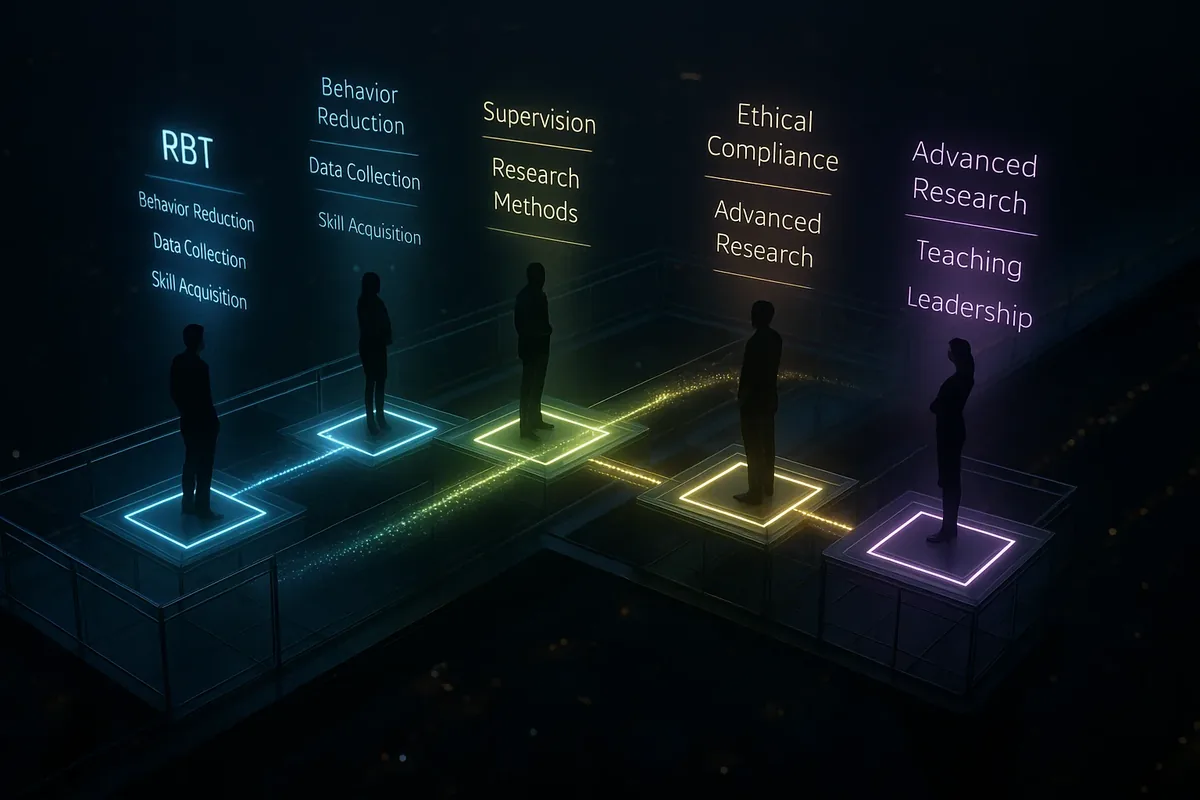
Becoming an RBT is the entry point in the field of behavior analysis. From there, you can advance. Here’s one possible path (you don’t need to be an RBT or BCaBA to become a BCBA):
RBT ➝ BCaBA ➝ BCBA ➝ BCBA-D
(Technician ➝ Assistant Analyst ➝ Analyst ➝ Doctoral-level Analyst)
The certification process is created and managed by the Behavior Analyst Certification Board (BACB).
To become eligible for an RBT exam, the candidate must meet these requirements:
- Be at least 18 years old.
- Have a high school diploma or equivalent.
- This means either a U.S. high school diploma, GED, or an international credential equivalent to a U.S. secondary education level.
- Pass a background check.
- Complete 40 hours of ABA training.
- Show practical skills in a competency assessment with a supervisor.
- This involves showing your ABA skills in real-life situations under supervision.
- Submit an application to the BACB.
- Pass the RBT exam.
Official guidance like the RBT Handbook, the Ethics Code, and updates on the BACB website helps candidates stay on track.
RBT Exam Structure: What to Expect on Test Day
The RBT exam tests your understanding of applied behavior analysis (ABA). It’s managed by the Behavior Analyst Certification Board (BACB) and must be taken in person at Pearson VUE centers.
Key RBT Exam Details: Questions, Time, and Format
| Aspect | Detail |
| Total questions | 85 |
| Scored questions | 75 |
| Unscored pilot questions | 10 |
| Time limit | 90 minutes (about 1 minute per question) |
| Question type | Multiple-choice (4 options, 1 correct) |
| Delivery Format | In-person at Pearson VUE testing centers |
| Exam appointment fee (Pearson VUE) | $45 |
| Application fee (BACB) | $65 |
The pilot questions don’t count toward your score but look just like the others; treat every question seriously.
You’ll have just over 1 minute per question, so time management is key.
Get ready for exam day. Take a free RBT mock test to check your knowledge and build confidence.
In-Person Experience At Pearson VUE Testing Centers
As of September 1, 2023, all RBT exams must be taken in person at Pearson VUE testing centers. Remote exams are no longer available due to security risks. Expect a strict check-in process:
- Photo taken
- Palm vein scan
- Electronic signature
- One valid, unexpired ID
- What counts: Government-issued, original and current, with your photo and signature (e.g., passport or driver’s license)
- No second ID needed: your one ID and your locker key are the only items allowed in the testing room.
Your name on your ID must match exactly with your BACB account. Any mismatch will result in denied entry.
Arrive 30 minutes early to avoid delays. Lockers are available for personal items, which are not allowed in the testing room.
Authorization to Test (ATT)
Once your RBT application is approved, you’ll receive an Authorization to Test (ATT) email. Use it to schedule your exam through Pearson VUE. Slots can fill quickly. Book early, especially in busy regions.
RBT Exam Content: The Test Content Outline (3rd Edition)
Since January 1, 2026, the RBT exam has been built from the RBT Test Content Outline (3rd Edition), which replaced the RBT Task List (2nd Edition). The outline lists 43 tasks in six content areas. The 40-hour training and the Initial Competency Assessment have their own BACB documents, and the training outline flags which of its topics are in the TCO. Every scored question maps back to one of those 43 tasks.
The six content areas (with the old 2nd Edition names)
- A. Data Collection and Graphing (was Measurement) – continuous and discontinuous measurement, data entry and graphing, describing what a graph shows.
- B. Behavior Assessment (was Assessment) – preference assessments, assisting with functional assessments, and skill assessments under BCBA direction.
- C. Behavior Acquisition (was Skill Acquisition) – the largest area: discrete-trial and naturalistic teaching, prompting and fading, chaining, shaping, stimulus control, generalization and maintenance.
- D. Behavior Reduction – functions of behavior, antecedent strategies, differential reinforcement, extinction, and crisis or emergency procedures.
- E. Documentation and Reporting – session notes, objective reporting, and communicating with the supervisor.
- F. Ethics (was Professional Conduct and Scope of Practice) – the RBT Ethics Code (2.0), supervision requirements, boundaries, confidentiality and self-reporting.
2026 Question Distribution (3rd Edition)
| Content area | Scored questions | % of exam |
| A. Data Collection and Graphing | 13 | 17% |
| B. Behavior Assessment | 8 | 11% |
| C. Behavior Acquisition | 19 | 25% |
| D. Behavior Reduction | 14 | 19% |
| E. Documentation and Reporting | 10 | 13% |
| F. Ethics | 11 | 15% |
| Total scored questions | 75 | 100% |
| Unscored pilot items | 10 | – |
Behavior Acquisition and Behavior Reduction together account for 33 of the 75 scored questions (44%). Questions are equally weighted and your result is based on overall performance, not on a minimum score in each area, so a weak area can be offset by a strong one.
Take a Free Behavior Acquisition (Skill Acquisition) Quiz
Take a Free Behavior Reduction Quiz
What changed from the 2nd Edition Task List
- New names, same six-area structure: Measurement became Data Collection and Graphing, Assessment became Behavior Assessment, Skill Acquisition became Behavior Acquisition, and Professional Conduct became Ethics.
- More tasks: 43 tasks numbered A.1 to F.10 replace the 37 tasks (A-1 to F-5) in the 2nd Edition list.
- Weights shifted: Behavior Acquisition dropped from 24 to 19 questions, Behavior Reduction rose from 12 to 14, and Data Collection and Graphing rose from 10 to 13. Behavior Acquisition (25%) and Behavior Reduction (19%) still carry the most questions; Ethics is 15%.
- If you trained on 2nd Edition material: the concepts still apply, but check every domain name and task number against the current outline before exam day.
Regularly consult the BACB RBT page for the current outline and handbook, since the BACB updates both between exam cycles.
Master RBT Question Types Beyond Multiple Choice
The RBT exam is fully multiple-choice, but that’s not it. These aren’t simple recall questions. Many are scenario-based, designed to test how well you can apply your knowledge in real-life situations.
What Are Scenario-Based Questions?
Scenario questions describe a situation involving a client, an RBT’s response, or an environmental factor.
You’ll need to read the scenario and choose the best response based on your understanding of ABA concepts, like the ABC model, reinforcement, extinction, prompting, chaining, discrimination training, and generalization.
Examples of Scenario-Based Questions
- Measurement
Scenario: You are asked to track aggression. Each time it happens, you press a tally counter.
Question: What are you measuring?
Answer: Frequency - Assessment
Scenario: You present a child with two toys and ask them to choose. You repeat this until every item is paired.
Question: What type of assessment is this?
Answer: Paired Choice Preference Assessment - Skill Acquisition
Scenario: An RBT helps a child complete a puzzle by physically guiding them, then gradually reduces help.
Question: What strategy is being used?
Answer: Prompt Fading - Behavior Reduction
Scenario: A child throws toys whenever given a task they dislike.
Question: What is the likely function of the behavior?
Answer: Escape
Practice free RBT scenario-based questions here.

Scoring and Passing Score of RBT Exam
The RBT exam is criterion-referenced; a panel of BACB subject-matter experts uses the modified Angoff method to set the passing score.
The BACB does not publish a passing percentage; your report simply says pass or fail. We suggest about 80% of the scored questions (60 of 75) as a working benchmark. Treat that as a study target, not an official cut score, and aim higher on practice tests so you have a margin on exam day.
- Pass/Fail Report: You get your pass or fail result at the testing center. You can get a copy later in your Pearson VUE account under “View Score Reports.”
- Certification: Achieving a passing score makes you eligible for RBT certification (assuming all other requirements – training, competency assessment, background check – have been met).
- Retakes: If you fail, submit a retake application in your BACB account (available within 48 hours of the result) and book a new Pearson VUE appointment. The BACB currently charges no retake fee, but each appointment carries the $45 Pearson VUE fee. You must wait 7 days between attempts and may sit up to 8 attempts within 12 months of your initial approval; after that you must wait until the 12-month period ends, then reapply and meet the requirements again.
BACB data show that roughly three in four first-time RBT candidates pass. In 2025, 75% of 109,341 first-time test-takers passed, compared with 38% of 54,674 retakes. Earlier years were similar: 73% first-time in 2024 and 74% in 2023, with retake pass rates between 36% and 41%.
These figures vary by year and training quality, but they underscore that careful preparation significantly boosts your chance of passing on the first try.
How To Schedule an RBT Exam
Once your RBT application is approved by the BACB, you’ll receive an email with an “Authorization to Test” (ATT) letter. This allows you to schedule your exam through Pearson VUE, the exclusive test delivery partner for the BACB.
Schedule Your In-Person RBT Exam
- Visit PearsonVUE.com after receiving your ATT.
- Choose any available date/time at a local Pearson VUE test center.
- You have one full year to take the exam from the date of approval.
- After booking, you’ll receive a confirmation email with details.
RBT Test Availability
- RBT exams run frequently at Pearson VUE centers in the US, in Canada (outside Quebec and Ontario) and, until January 1, 2027, in Australia.
- $65 BACB certification application fee (paid when applying; 2026 RBT Handbook).
- $45 Pearson VUE exam fee per appointment, paid when you schedule (moving it is free 31 or more days out, then $27 or $32 closer to the date).
Test Security
- No personal items allowed in the testing room (lockers provided).
- No food or drink in the testing room. You can have food, drink or medication during breaks.
- Surveillance cameras are active throughout the exam.
- You can take breaks, but the clock keeps running, and you can’t leave the building.
Remote (At-Home) RBT Testing
As of September 1, 2023, online testing (OnVUE) is no longer available for RBT candidates. All exams must be taken in person at a Pearson VUE center.
Note: BCBA and BCaBA exams are in person too. The BACB delivers all its exams at Pearson VUE testing sites and US military bases.
There’s no at-home option for the RBT exam, so plan to book a test center.
Conclusion
So, what’s your story going to be?
Will you be the one who walks out of that testing center with a huge smile, texting everyone “I PASSED!”?
Or will you be the one making excuses about why you need to retake it?
The choice is yours, but here’s what we know: Every successful RBT started exactly where you are right now.
Nervous. Uncertain. Maybe a little overwhelmed by all the information.
But they had one thing in common: they decided to take action.
Here’s the thing… You don’t have to figure this out alone.
You don’t have to waste time with outdated study materials or wonder if you’re focusing on the right content. These comprehensive mock tests mimic the real RBT exam format, timing, and difficulty level.
- Realistic scenario-based questions
- Domain-by-domain score breakdown
- Personalized study recommendations
- Instant results and progress tracking