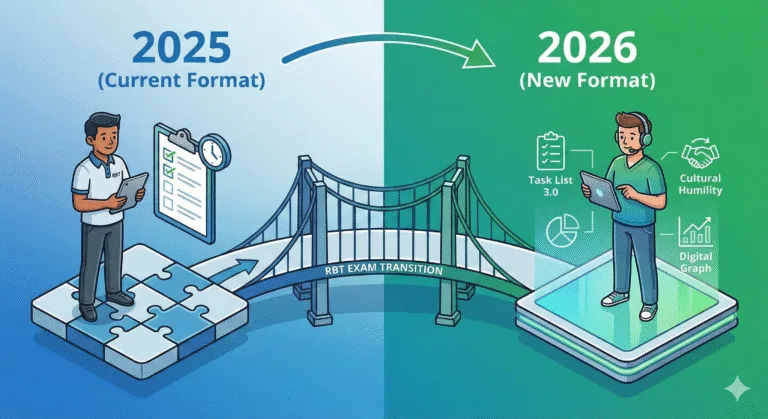
Updated September 2026 to reflect the 2026 BACB RBT requirements (RBT Handbook, updated June 2026).
Whether you’re prepping for the RBT certification exam, just finished your 40-hour RBT training, or still deciding if this path is right for you. You’re probably feeling the pressure.
Deadlines, paperwork, and requirements seem straightforward until one detail slips through the cracks.
RBTs are in high demand for good reason. Entry-level RBTs earn $35,000-$45,000 annually, with opportunities in ABA clinics, schools, hospitals, and private practice settings.
This credential can lead to steady, meaningful work in behavior analysis. But before you get there, the process matters.
So, how do you get RBT certification without wasting time or money?
Many candidates make small, avoidable mistakes such as outdated training, missed deadlines, and unclear next steps. These can stall your progress.
This guide explains exactly what RBTs do, the 2026 eligibility rules, key steps to certification, and how to avoid common setbacks.
RBT Quick Start Checklist
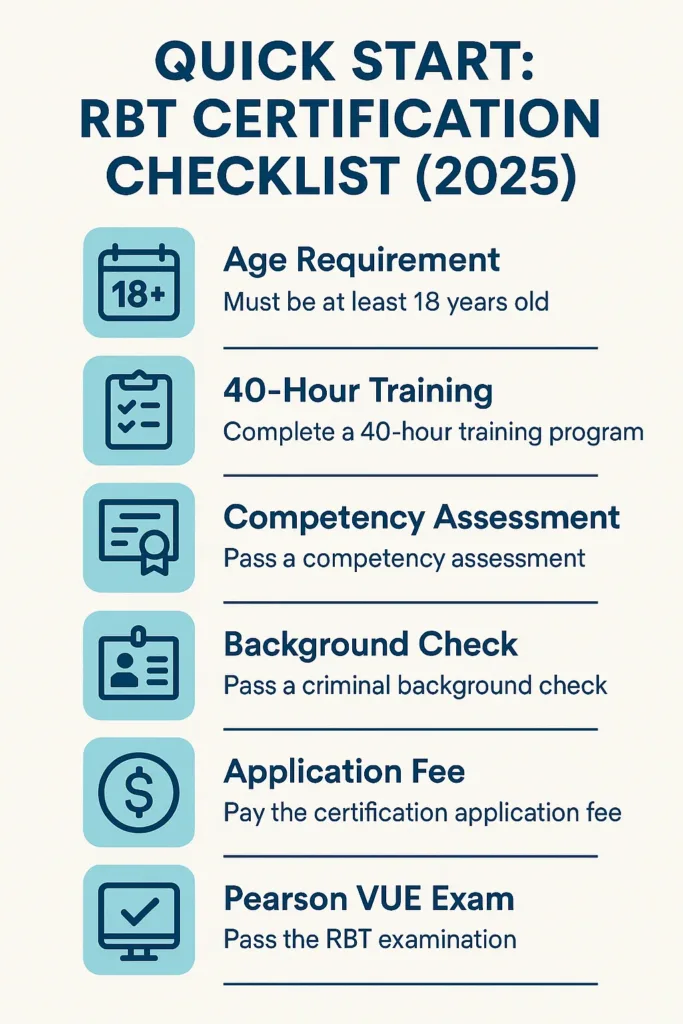
Save this checklist to track your progress:
- Confirm you’re 18+ with a high school diploma/equivalent
- Complete a 40-hour RBT training that follows the BACB 2026 curriculum outline (taken over 5 to 180 days)
- Pass RBT competency assessment with qualified BCBA/BCaBA
- Submit background checks (criminal + abuse/neglect registry)
- Apply online with BACB ($65 application fee in 2026)
- Schedule and pass the RBT certification exam at Pearson VUE centre ($45 fee)
- Secure ongoing supervision from BCBA/BCaBA
Total Timeline: 2-4 months
Total Cost: $125-$600+ depending on training provider
What is RBT Certification?
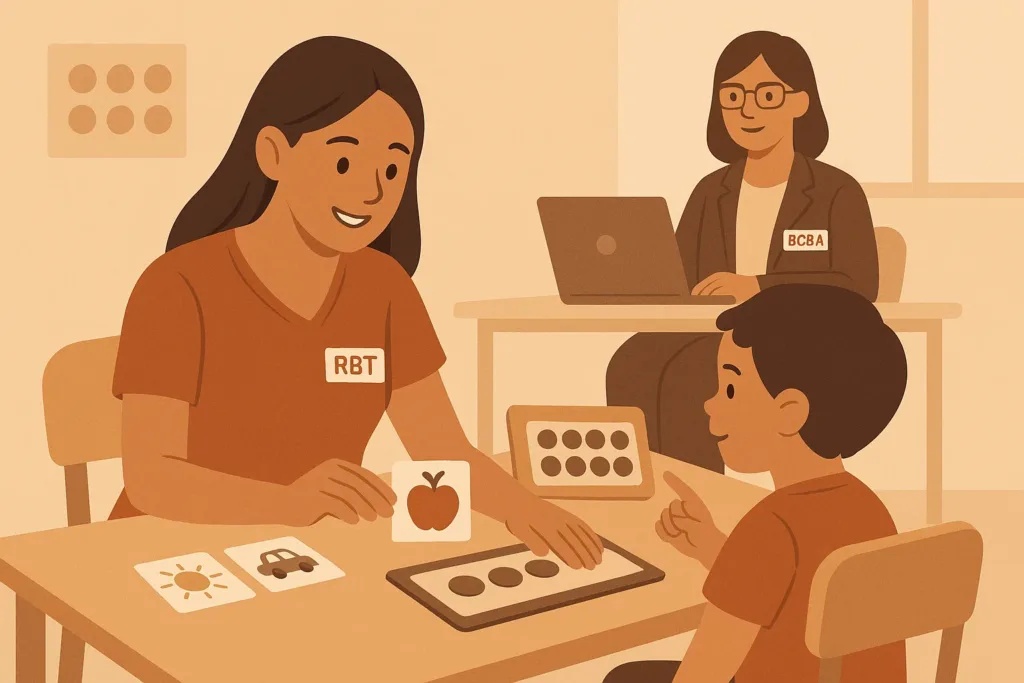
RBT stands for Registered Behavior Technician. It’s a professional certification for people who work directly with individuals who need behaviour support, often children or adults with autism or developmental delays.
For example, an RBT might help a child with autism learn to ask for a snack instead of grabbing it impulsively. Or they might support an adult in developing daily living skills such as, brushing their teeth or dressing independently.
This credential was created in 2014 by the Behavior Analyst Certification Board (BACB), the leading authority in the U.S. for Applied Behavior Analysis (ABA).
The “Registered” part means you’re officially certified by the BACB. RBTs work under the supervision of a Board-Certified Behaviour Analyst (BCBA) or Assistant Behavior Analyst (BCaBA).
Key Benefits of RBT Certification
- High job demand – Growing need for qualified behavior technicians across healthcare and education
- Clear career pathway – Foundation for advancing to BCBA or BCaBA roles
- Meaningful impact – Direct involvement in improving client outcomes and quality of life
- Competitive compensation – Entry-level positions typically start $35,000-$45,000 annually
- Flexible work settings – Opportunities in clinics, schools, homes, and community programs
The Role of an RBT in ABA Therapy
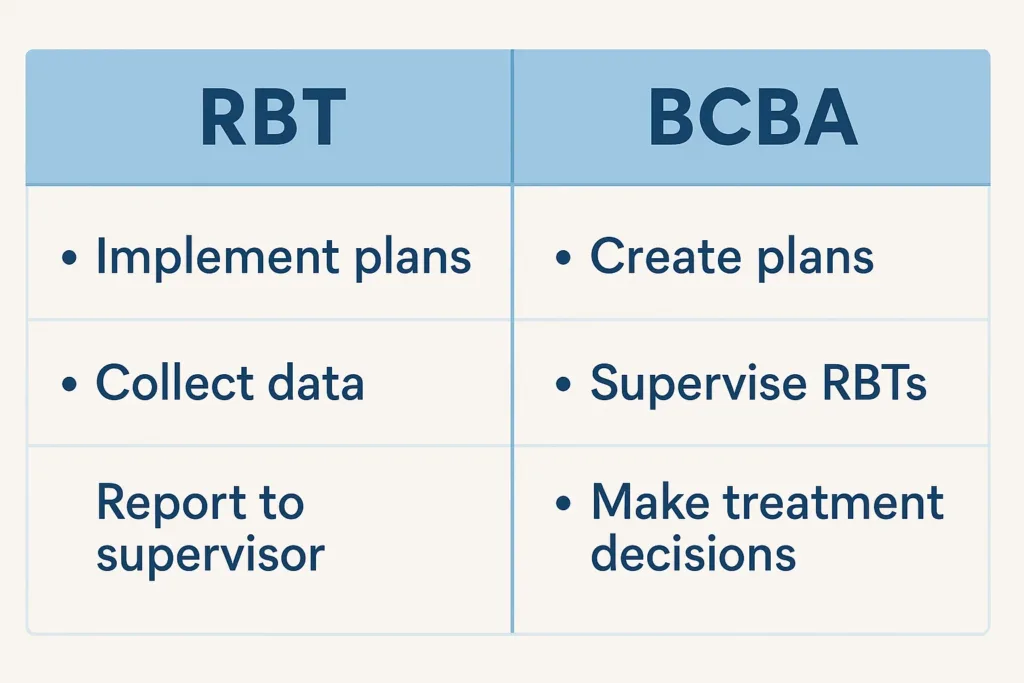
RBTs help carry out ABA (Applied Behavior Analysis) therapy plans under a BCBA’s or BCaBA’s supervision. Their job is supporting clients, following instructions, and reporting what happens during sessions.
The five principal duties of an RBT are:
- Follow Treatment Plans: RBTs teach skills and manage behaviour using specific steps given by their supervisor.
- Collect Data: They record how the client responds during each session to track progress.
- Prep Sessions: RBTs prepare materials (like toys or visuals) before sessions and review goals.
- Work With Clients: They create a calm, fun environment and use ABA techniques to help clients learn.
- Report to Supervisor: RBTs share session results with the BCBA, who updates the plan if needed.
For example:
An RBT works with a 5-year-old, learning to request items. The goal: teach the child to say “ball” to request play. Before the session, the RBT reviews the plan, prepares materials, and sets out preferred toys.
During the session, they prompt the child to say “ball” and reinforce attempts with praise and tokens. They track whether requests are independent, prompted, or missed.
Afterwards, the RBT reported to the BCBA that the child independently requested a “ball” three times, up from zero last week.
RBT Certification Online: Top Accredited Providers
| Provider | Cost Range | Format & Duration |
| Behavior University | $250-$400 | Self-paced online, 2-4 weeks |
| Autism Therapy Career College (ATCC) | $300-$500 | Live virtual sessions, 2-3 weeks |
| Florida Institute of Technology | $400-$600 | Hybrid online/in-person, 3-4 weeks |
Online vs In-Person Training:
Online RBT Training Pros: Greater scheduling flexibility, lower cost, learn at your own pace, access from anywhere
Online RBT Training Cons: Less hands-on practice, requires self-discipline, limited direct interaction with instructors
In-Person RBT Training Pros: More interactive learning, immediate feedback, networking opportunities, structured environment
In-Person RBT Training Cons: Higher costs, fixed schedules, travel requirements, limited availability in some areas
4 Essential Steps to RBT Certification
Step # 1: Complete Your 40-Hour RBT Training
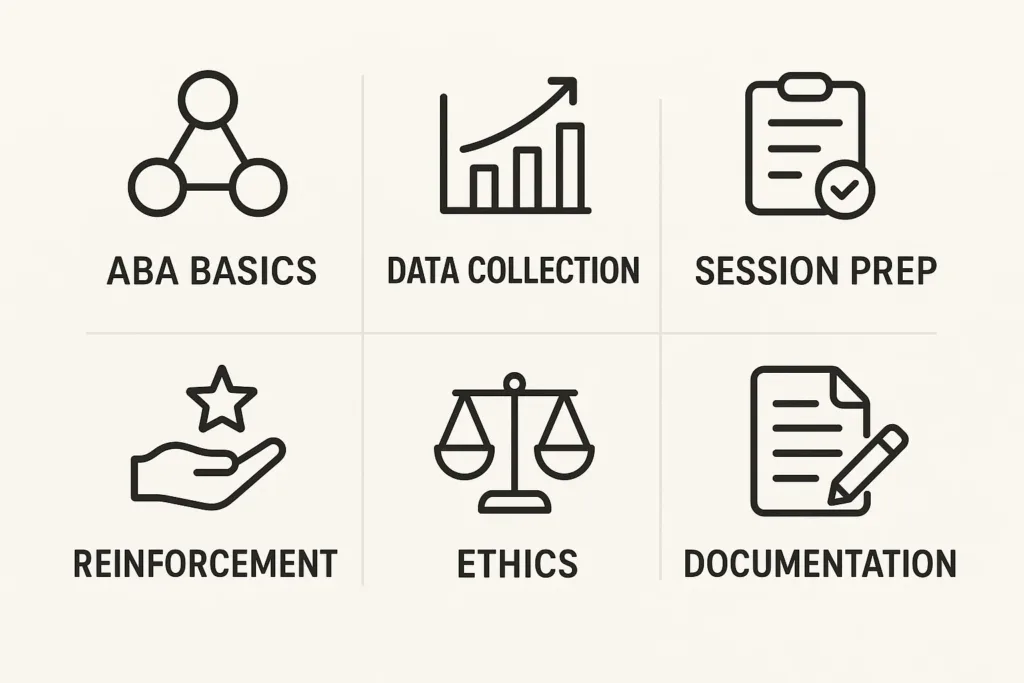
You must complete a BACB-approved 40-hour RBT training course to become an RBT. This course teaches the basics of Applied Behavior Analysis (ABA) and prepares you for real client work.
Typical Cost Range: $200-$500
Here’s what you learn in a 40-hour training course:
- ABA Basics: How behaviour works, what reinforces it, and how to identify why a behaviour is happening.
- Getting Ready for Sessions: How to set up the space, gather materials, and build client trust.
- Taking Data: How to track behaviour accurately using tools like timers, charts, and graphs.
- Helping with Assessments: How to assist your supervisor with testing what a client likes or what skills they have.
- Using Behavior Strategies: You’ll learn how to apply core ABA techniques, like prompting, reinforcement, extinction, and shaping, step by step.
- Reporting & Documentation: How to write clear notes, protect client privacy, and follow reporting rules.
- Ethics & Conduct: You’ll study the RBT Ethics Code, learn to stay professional, avoid boundary issues, and report concerns.
Training is done through videos, examples, role-play, and interactive lessons. The 2026 version requires:
- 20 hours focused on teaching behavior strategies
- 3+ hours dedicated to ethics and professionalism
Training Timeline: The course cannot be completed in fewer than five calendar days, and it must be completed within six months or 180 days.
How to Choose an Online RBT Training Provider – 3 Key Tips
- Check refund policies – Ensure you can get money back if the program doesn’t meet your needs.
- Review live instruction hours – Some programs offer more interactive sessions than others.
- Read recent student reviews – Look for feedback on course quality and exam preparation effectiveness.
It’s essential to pick a course that follows the latest BACB rules: the RBT 2026 40-Hour Training Requirements and Curriculum Outline, the Test Content Outline (3rd Edition), and the RBT Ethics Code (2.0). The certificate must state that the course is designed to meet the 2026 training eligibility requirement.
Prepare for your exam with our Free RBT Practice Test – built around the six content areas of the BACB Test Content Outline (3rd Edition), with exam-style questions.
2. Pass the Competency Assessment
After completing your 40-hour RBT training, passing the RBT Competency Assessment is necessary. Since January 1, 2026 it uses the updated RBT Initial Competency Assessment packet (19 tasks) and must be completed on the official BACB form.
The assessment must be done after training and within 90 days of submitting your RBT application. If it’s done too early, it won’t be accepted.
The assessment includes all required RBT skills and is typically done in a clinic over one or more sessions. The assessor, usually a BCBA, will test your skills in three ways:
- With a Client: You demonstrate a task (e.g. data collection or prompting) in a real session.
- Role-Play: You act out the task with someone pretending to be the client.
- Interview: You explain concepts verbally (e.g. “What is reinforcement?”).
Preparation Tips
- Use the Test Content Outline (3rd Edition) to self-quiz on key concepts
- Practice with a mock client using common ABA techniques
- Review your 40-hour training materials, especially ethics scenarios
If you don’t perform a task correctly, your assessor will give feedback and test you again later. You must pass every item.
Once all functions are passed, your assessor will sign and date the form. You’ll then submit this completed form with your application.
Who Can Administer The Competency Assessment?
Only a qualified assessor can oversee and sign off on the RBT Competency Assessment. This person must:
- Be a BCBA or BCaBA
- Have completed 8 hours of supervision training
- Be employed at the same organization as, or have a contractual relationship with, the applicant and the clients involved in the assessment
- Not be related to, subordinate to, or employed by the applicant (the assessor may be the same person who delivered your 40-hour training, and may delegate tasks to an assistant assessor who holds RBT certification or higher)
- Not be a family member or subordinate of the applicant
- 3. Submit Background Check & Fingerprinting
Before applying for certification, you need to complete a criminal background check and abuse registry screening.
Requirements vary by state, so understanding your local rules is vital. You must complete the background check within 180 days before submitting your BACB application.
- 4. Schedule Your Exam and View Results
Here is a six-step process to schedule your exam.
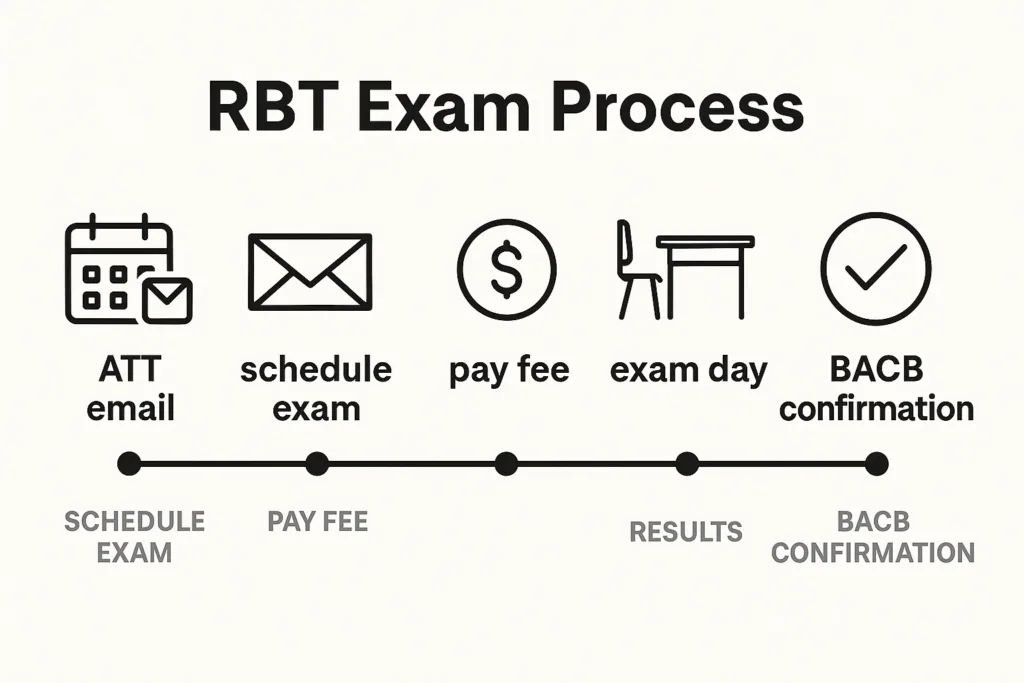
Step 1: Receive Your Authorization-to-Test (ATT) Letter
Once the BACB approves your RBT application, you’ll receive an Authorization-to-Test (ATT) email. This confirms you’re eligible to sit for the exam.
Step 2: Schedule Your Exam with Pearson VUE
You’ll follow the instructions in the ATT email to create or log in to your Pearson VUE account. Schedule your RBT certification exam, and choose your preferred testing centre, date, and time. All exams must be in-person; remote testing is no longer offered.
Step 3: Pay the Exam Fee
You’ll pay the $45 exam appointment fee directly to Pearson VUE when scheduling.
Step 4: Take the Exam In Person
Arrive early at your selected test centre with a valid government-issued ID. The exam is 90 minutes long and includes 85 multiple-choice questions.
Step 5: Get Immediate Results
Your pass/fail result is displayed immediately after the exam. You won’t see a numerical score, just whether you passed.
Step 6: Confirmed Results via BACB Account
Within about one week, the BACB will confirm your results and update your status in your BACB account. You’ll also receive an official email. If you pass, your RBT certification remains inactive until you list a qualified supervisor.
RBT Exam Details
Once your competency assessment is complete and approved, you’ll register for the RBT exam through the BACB.
Format: Computer-based, multiple choice
Duration: 90 minutes
Questions: 85 total (75 scored, 10 pilot questions)
Location: Pearson VUE testing centres only (remote testing discontinued)
Passing Standard: Criterion-referenced (not curved)
Questions assess your practical understanding of the RBT Test Content Outline (3rd Edition), covering data collection and graphing, behavior assessment, behavior acquisition, behavior reduction, documentation and reporting, and ethics. There’s no penalty for guessing.
Complete Fee Breakdown:
- BACB application: $65 (2026, non-refundable)
- Exam appointment (Pearson VUE): $45
- Background check: $30–$60 (varies by provider)
- Competency assessment: $50–$500 (often included in training)
Retake policy: If you fail the exam, you’re allowed up to eight attempts within 12 months. You must wait at least seven days between each attempt. There is no additional application fee for retakes; reschedule through Pearson.
RBT Application and Renewal Process
Required Documents and Eligibility Checklist (as of 2026)
Before applying, ensure the following items are complete and documented:
| RBT Certification Requirements (2026) | |
| Requirements | Details |
| Age | 18+ years old |
| Education | High school diploma or equivalent |
| Background Check | Must pass a criminal background check |
| Training | Complete a 40-hour RBT training course that follows the BACB 2026 curriculum outline, taken over 5 to 180 days |
| Competency Assessment | Pass the RBT Initial Competency Assessment (19 tasks) with a qualified assessor, no more than 90 days before you apply |
| Final Exam | Pass the RBT certification exam |
Renewal Timeline and CE Requirements
Your certification carries an expiration date tied to the day you first passed the exam. 2026 is a transition year, so what you do depends on when you recertify:
- Recertification Competency Assessment (2026 recertifications only): If you recertify in 2026, a qualified assessor observes your work and completes the RBT Recertification Competency Assessment, which you upload with your application. It is the last time the assessment is required.
- Renewal Fee: The 2-year recertification application fee is $50 from January 1, 2026 (late fee $50; 30-day reinstatement period).
- Continuing Education (CE): Good news for 2025: RBTs do not need CEUs. The renewal assessment alone confirms that your skills are still strong and up to date.
What’s Changing in 2026?
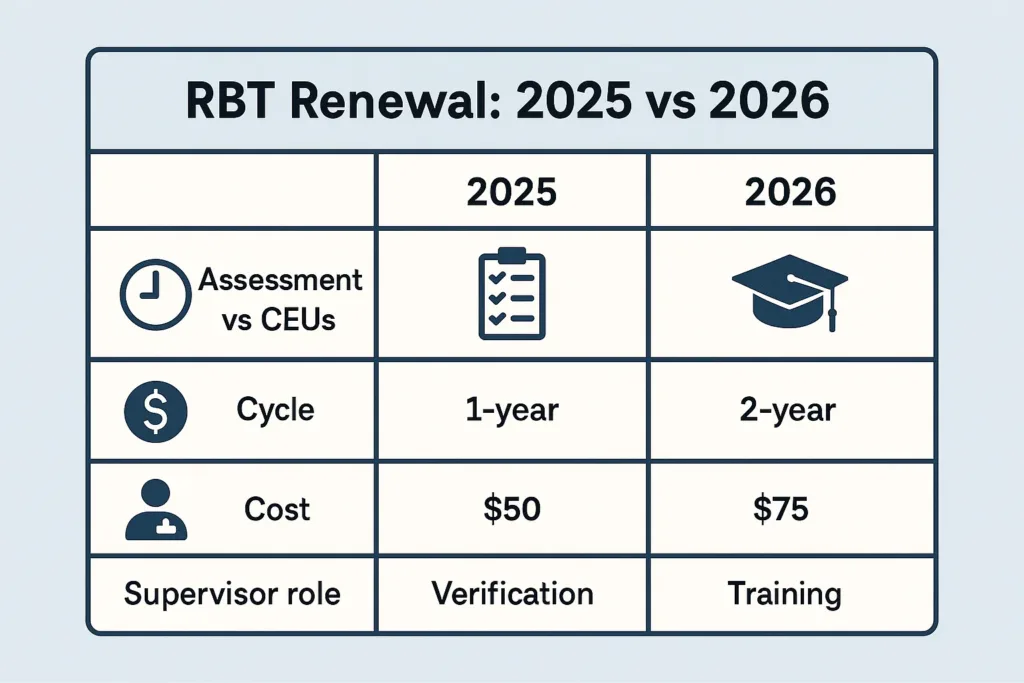
- After your 2026 recertification (or from the start, if you are first certified in 2026), the cycle becomes two years.
- From 2028, each two-year cycle requires 12 professional development units (PDUs) and no competency assessment. PDUs come from in-service training at your employer, ACE-provider events, or university behavior-analytic coursework (grade C or better).
- From then on, CE hours will replace the yearly test. Approved CE may include webinars or workshops, college-level courses, and conference sessions on ABA topics.
Frequently Asked Questions (FAQs)
- What if I fail the RBT Exam? Can I retake it?
Yes. You can retake the RBT exam up to 8 times within a 12-month authorization period. If you fail, the BACB will send instructions on how to reschedule.
- Do I Need a BCBA to Conduct My Competency Assessment?
Yes. A qualified assessor must conduct your Competency Assessment, either a BCBA, BCaBA or someone who meets the BACB’s requirements. The assessor must hold an active certification and be in good standing.
- How Long Does RBT Certification Remain Valid?
It depends on when you were certified. RBTs recertifying in 2026 complete the Recertification Competency Assessment one last time and then move to a two-year cycle; RBTs first certified in 2026 receive a two-year certification. From 2028, each two-year cycle requires 12 PDUs and no assessment. The recertification application fee is $50, and supervision requirements (at least 5% of service hours each month) continue throughout.
- Can I Complete My 40-hour RBT Training Online?
Yes, many BACB-approved providers offer online RBT training. However, the training must still meet all BACB requirements, including the minimum 5-day completion period and 180-day maximum timeframe, and it must be delivered by an active BCBA or BCaBA who has completed the 8-hour supervision training.
- What happens if I don’t renew on time?
If you miss your date, your certification becomes inactive and you have a 30-day reinstatement period to submit an approvable application (with a $50 late fee). After that, the certification expires and you must complete the full certification process again, including retaking the exam.
Conclusion
Becoming an RBT is an entry point into the growing field of behaviour analysis. While the steps are structured, minor timing, documentation, or supervision errors can cause significant delays.
By following the correct process, and using reliable tools like BACB’s official resources and study aids, you can become certified efficiently and confidently.
Next Step: If ready to begin, choose a reputable 40-hour RBT training provider and track your certification progress against the checklist above.
Prepare for success: Use our Free RBT Practice Test to build confidence with real exam-style questions designed after the official BACB Task List.