
You’ve studied for weeks. You know your reinforcement schedules, your ABC data, your ethical codes. You walk into that testing center feeling confident.
Then you fail.
What went wrong? It wasn’t your knowledge, it was the hidden traps behind why 25% of first-time test-takers didn’t pass in 2025.
The rbt exam mistakes have nothing to do with how smart you are and everything to do with strategy.
Many avoidable mistakes come down to misreading questions, running out of time, or forgetting key logistics.
Shaky on the content as well? Our free RBT exam study guide walks through all 43 tasks, one area at a time.
Ready to beat the odds?
Take the free RBT mock test with real RBT exam format.
In this blog, we’ll share 7 rbt exam mistakes one by one, with clear examples, study strategies, and exam-day tactics so you can walk in confident, and focused.
Let’s dive in.
Mistake # 1: Neglecting the RBT Test Content Outline During Study Prep
Would you ever ignore the one document you know your entire exam is based on? Sounds silly, right?
Yet that’s exactly what happens when students neglect the RBT Test Content Outline and rely only on random study guides or AI summaries. This is one of the most critical rbt exam mistakes that candidates make.
Here’s the truth.
The RBT Test Content Outline (3rd Edition) is the official blueprint published by the BACB, and the exam has been built from it since January 1, 2026. Every scored question on your test ties back to one of its 43 tasks. If you skip it, you’re setting yourself up for blind spots. Study materials that still refer to the old “RBT Task List (2nd Edition)” were written for the previous exam.
Now, the outline can look overwhelming at first. It covers six content areas: Data Collection and Graphing, Behavior Assessment, Behavior Acquisition, Behavior Reduction, Documentation and Reporting, and Ethics.
That’s a lot to digest for a newcomer. But here’s one of the most effective rbt exam tips: don’t tackle it all at once; break it into chunks, and weight your time by how many questions each area carries.
For example:
- Monday → Data Collection and Graphing (13 of the 75 scored questions)
- Wednesday → Behavior Acquisition, the largest area (19 of 75, or 25%)
- Friday → Behavior Reduction (14 of 75) and Ethics (11 of 75)
See how much easier it feels when you spread it out? Even just 15 minutes a day adds up to more than an exhausting cram session the night before.
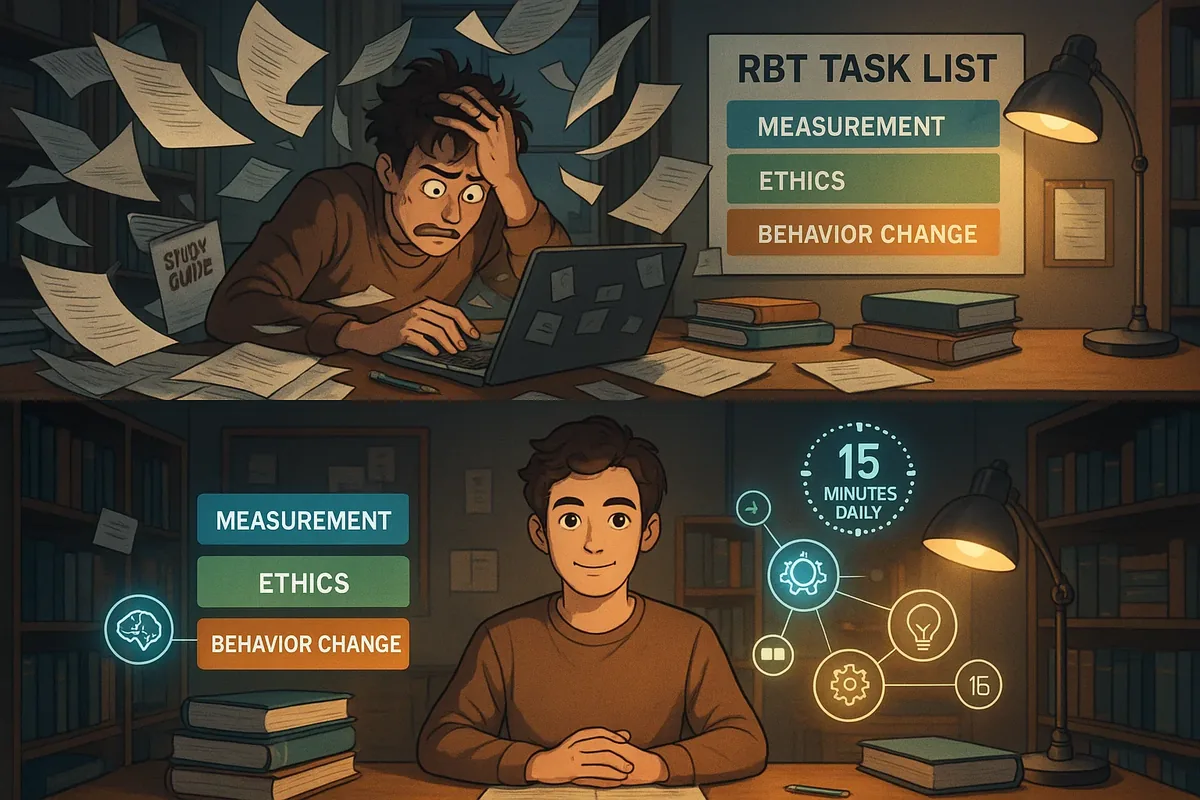
And yes, AI tools (like ChatGPT) are useful, but only if you use them to support the content outline, not replace it.
For example, you can ask AI to create flashcards from one content area at a time. This structured approach will also make your rbt practice test sessions more effective, since you’ll have a solid foundation in each area.
Mistake # 2: Treating Practice Tests as Optional Add-Ons
Be honest, have you ever thought, “I’ll just stick to my notes; I don’t really need to waste time on practice exams”?
That’s one of the biggest mistakes RBT exam mistakes candidates make.
Here’s the thing… RBT practice test sessions are part of the training itself. They teach you the rhythm of the exam, how to pace yourself, and how to think under pressure.
The good news is that you don’t even have to spend money. You can undergo free mock tests online that cover every domain. You’ll usually find two formats:
- Domain-specific mock tests (e.g., Data Collection and Graphing only, Ethics only).
- Full-length combined mock tests (all domains mixed, just like the real exam).

Here’s a practical rbt exam tips strategy you can follow:
- Start with domain-specific tests. Example: Take a “Data Collection and Graphing” mock test. If you score low, you instantly know that’s a weak spot. Do this for every domain once. It gives you a baseline.
- Move to full-length tests. After you’ve reviewed weak areas, take a full rbt exam practice test under timed conditions (quiet space, 90 minutes, no notes).
- Review smarter. Don’t just look at your score. Go through each wrong answer. Example: If you missed a question on ABC data, don’t just memorize the right answer, go back and study what ABC really means and how it applies in practice.
- Repeat with variety. Take at least 3–5 full mocks during your prep. The repetition helps you spot patterns and builds confidence.
During a full-length mock, you realize you’re taking too long on scenario questions (3+ minutes each). That’s a red flag you’d never catch from just reading notes. RBT practice test sessions teach you to pace yourself before it costs you points.
Mistake # 3: Poor Time Allocation Strategies on Test Day
The RBT exam gives you 85 questions in 90 minutes. That’s a little over one minute per question. Sounds doable, right? Yet, many test-takers fail not because they ran out of time.
Think about it, spending 5 minutes stuck on one tricky scenario question means you’ve just sacrificed the chance to answer 4 or 5 easier ones. That’s a costly mistake and one of the most avoidable rbt exam mistakes.
How to Manage Time
- Use the 2-minute rule. If a question is eating up more than 2 minutes, stop. Flag it, move on, and come back later. This strategy becomes second nature when you practice it during your rbt practice test sessions.
- First pass → second pass strategy.
- First pass (60–70 minutes): Answer everything you know right away. Don’t get hung up.
- Second pass (20–30 minutes): Return to flagged or tough ones with a clearer head.
- First pass (60–70 minutes): Answer everything you know right away. Don’t get hung up.
- Never leave blanks. There’s no penalty for guessing. If you’re down to the last minute, eliminate the obvious wrong answers and make your best guess. A 25% chance of getting it right is way better than a guaranteed 0.
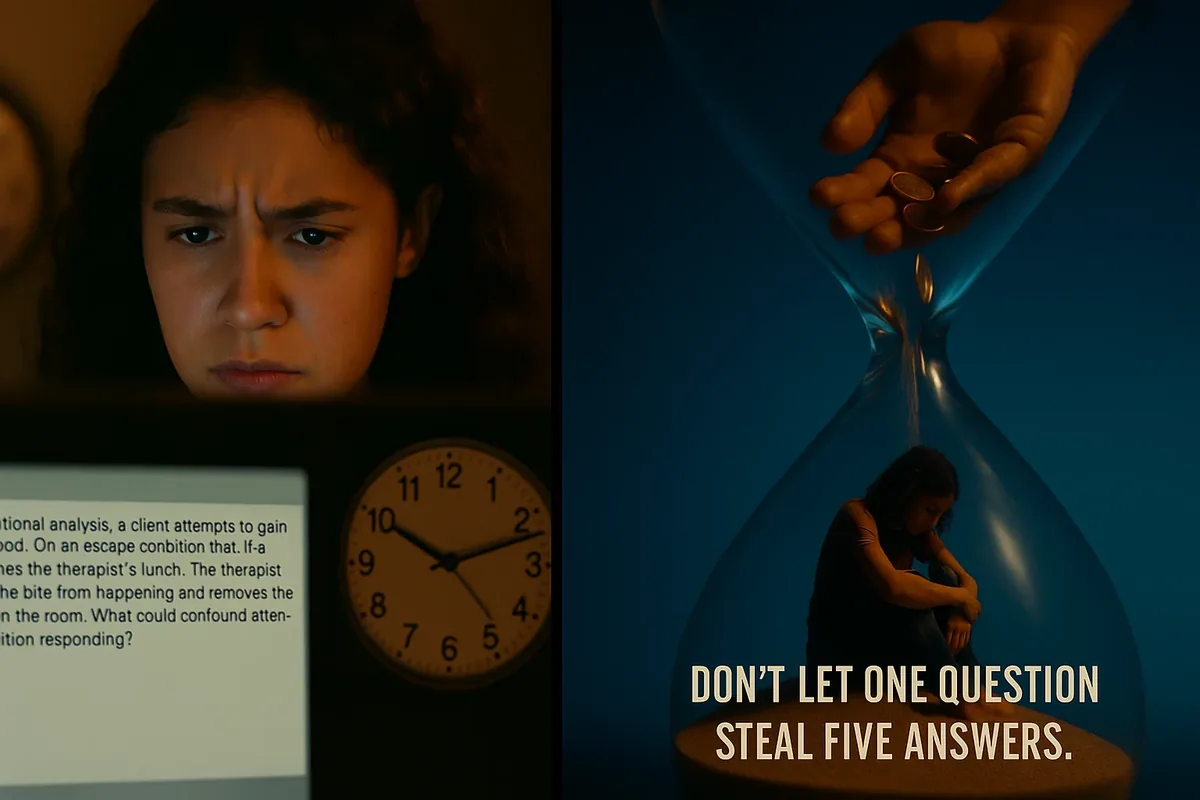
This is one of the most effective rbt exam tips for avoiding panic.
Mistake # 4: Ignoring Critical Test Day Logistics
You could study for weeks, know the content outline inside out, and still blow your exam day if you ignore the logistics. Don’t let logistical oversights become unnecessary rbt exam mistakes.
What You Must Bring vs. What to Leave at Home
| Allowed (Bring) | Prohibited (Leave at Home) |
| One valid ID (government-issued, original, current, with photo + signature) | Cell phones, smartwatches, tablets |
| Your locker key (the center gives you one; it’s the only other item allowed in) | Scratch paper, calculators, rulers |
| Nothing else. Earplugs (on request) and a dry-erase board are provided | Food or drinks in the exam area |
Pro tip: Your ID must exactly match your BACB account name. If your BACB account says “Katherine” but your ID says “Kate,” fix this before test day.
Before Exam Day
- Complete admin steps. Submit proof of your 40-hour training and Initial Competency Assessment.
- Review the RBT Handbook. Know the policies, ethics code, and exam rules.
- Check your route. Know how long it takes to get to the test center (including parking or transit delays).
On Exam Day
- Arrive 30 minutes early. If your test is at 9:00 AM, aim for 8:30.
- Use lockers. Phones, wallets, keys and all personal belongings go in a locker. Don’t bring notes thinking you’ll “squeeze in last-minute studying”, they’re not allowed.
- Follow check-in procedures calmly. Expect ID checks, a photo, a palm vein scan, and agreeing to the exam Terms and Conditions before you start.
- Stay calm if tech glitches happen. If the computer acts up, tell the proctor. Proctors help with operational issues, and if testing conditions go wrong (like long screen-load times), you can file an exam appeal with the BACB within 7 days.
Mistake # 5: Misunderstanding Behavioral Measurement and Data Collection
One of the easiest ways to lose points on the RBT exam is by confusing measurement terms or misreading data displays. These questions show up often, and they’re tricky because the differences are subtle but critical.
Let’s break them down with plain examples:
| Term | What It Means | Example |
| Frequency | Count of how many times a behavior occurs | A child claps 12 times during circle time |
| Rate | Frequency over a set time period | 3 tantrums per hour |
| Duration | How long the behavior lasts | Tantrum lasted 3 minutes |
| Latency | Time from instruction/prompt to start of behavior | 5 seconds after “sit” before child sits |
| Interresponse Time (IRT) | Time between one behavior and the next | 10 seconds between each hand-flap |
Graphs: Read Them, Don’t Just Glance
Many RBT exam questions include graphs. Here’s what to check:
- Axes: Time should be on the x-axis, behavior on the y-axis. Mislabeling or unusual scaling can trick you.
- Level, trend, variability: Is the behavior stable, increasing, or bouncing all over?
- Scale awareness: If the y-axis only goes up to 10, but the behavior spikes at 15, you might miss the real change. Always read the labels.
Pro tip: On the exam, slow down and match the behavior being measured with the right method. That one extra second of clarity can save you from easy mistakes.
When you’re taking an rbt exam practice test, pay special attention to data collection scenarios. Data Collection and Graphing is 13 of the 75 scored questions (17%), and the details are easy to mix up.
Mistake # 6: Falling Into Question Misinterpretation Traps
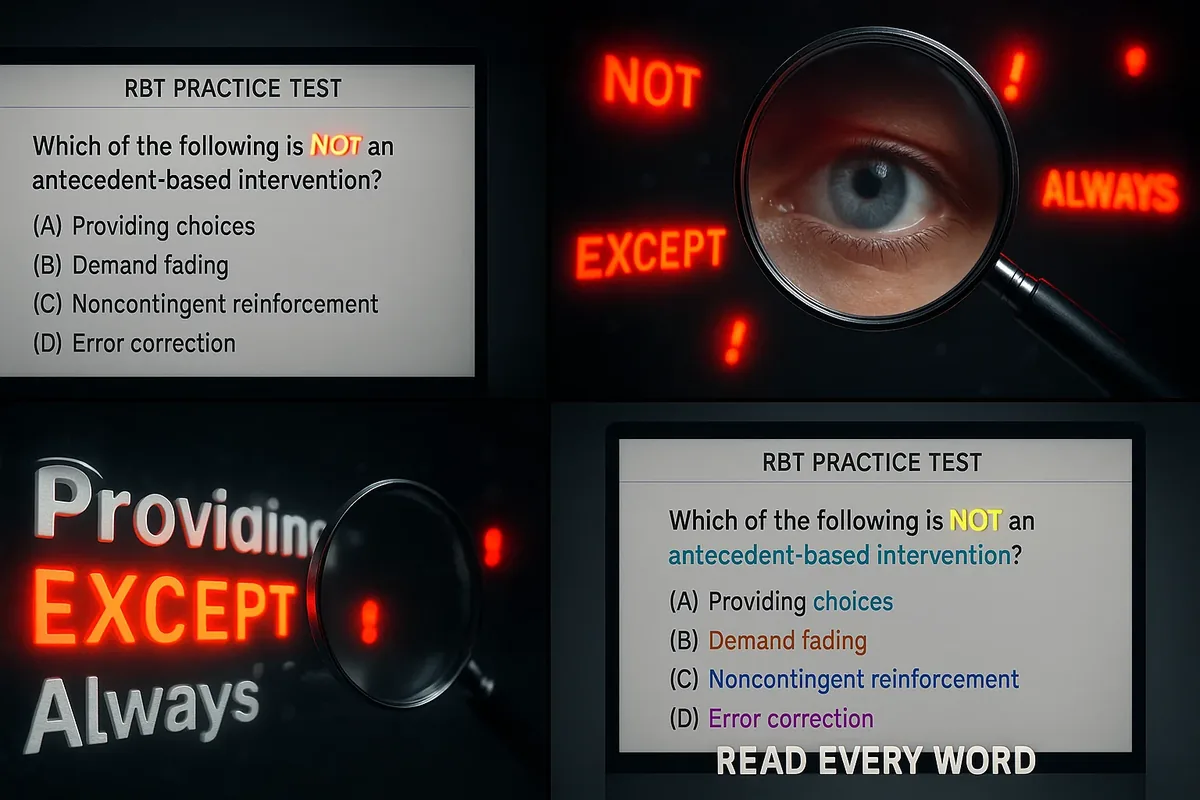
Multiple-choice questions often contain qualifiers and tricks. The art of reading ABA scenario questions is to slow down and pay attention to every word.
Think about it. A single word like “always” or “except” can change everything. For example:
- Which of the following is NOT an example of reinforcement?
If you skim, you’ll answer as if it is asking for reinforcement. That’s an instant mistake and one of the most common rbt exam mistakes.
How to Avoid the Trap
- Highlight the qualifiers. Words like always, never, except, prior to, most likely are your red flags. Circle them, underline them, or repeat them in your head before even looking at the answers.
- Answer in your own words first. Before glancing at the options, pause and think: “What’s the question really asking me?” If the stem says, “What should the RBT do first when…?” come up with your own “first step” answer in your mind.
- Use elimination. Cross out any choice that’s clearly wrong. For example, if a question is about ABC data collection and one option says “teach a new skill,” you know that doesn’t belong.
- Double-check scenario details. Many scenario questions add small timeframes or conditions like “every 10 minutes” or “before the intervention.” If you miss these, you’ll pick an answer that doesn’t fit.
A Quick Example
Question: An RBT is asked to collect frequency data. The supervisor instructs them to record the number of times a child raises their hand during a 30-minute session.
What should the RBT do?
If you skim and miss “30-minute session,” you might choose “record how long the child’s hand stays raised” (which is duration, not frequency). See how a single phrase makes the difference?
Mistake # 7: Viewing a Failed Attempt as a Final Failure
Not passing the RBT exam on your first try is feedback, not final failure. In fact, about 75% of first-time candidates passed in 2025, which means many succeed only after regrouping and retaking.
| Steps | What To Do | Why It Matters |
| 1. Decode Your Score Report | Log into your Pearson VUE account, select “View Score Reports,” and use any feedback it gives on weaker areas. | Shows where to focus your retake study, if your report includes area feedback. |
| 2. Build a Targeted Retake Strategy | Deep-dive into weak areas using active learning (flashcards, teaching others, concept maps). | Understanding beats memorization. You need to know why answers are correct. |
| 3. Use Practice Tests as Diagnostics | Take a timed rbt practice test under real test conditions, then review every mistake. | Helps you separate knowledge gaps from test-taking errors. |
| 4. Consider Refresher Training | If you’ve failed multiple times, revisit RBT course modules or seek tutoring. | Identifies and fills foundational knowledge gaps. |
| 5. Manage the Psychological Side | Set a study timeline (BACB requires a 7-day wait), prioritize sleep, and manage anxiety. | Keeps you disciplined without burnout. Mental clarity boosts performance. |
Conclusion
The RBT exam is all about preparation.
You now know the 7 RBT exam mistakes that derail most candidates. More importantly, you have specific strategies to avoid them.
Content outline mastery, strategic RBT practice test sessions, careful question reading, smart time management, proper logistics, measurement clarity, and resilient retake planning.
Here’s what separates passers from failers: consistent action on these RBT exam tips.
Don’t just read this and move on.
Set your content-area study calendar. Practice the 2-minute rule. The exam doesn’t care how much you know, it rewards how well you execute under pressure.
Your RBT certification is waiting. Time to claim it.
Start with a Free RBT Mock Test and see exactly where you stand.