If you could go back and give your “day-one-of-studying” self some advice, what would it be?
Probably this: “Focus on these exact strategies!”
Time travel might not exist, but these RBT exam preparation tips are the next best thing.
Instead of wasting hours on scattered notes or passive rereading, you’ll learn how to target the areas that actually trip up candidates.

In this blog, we’ll break down the top 5 most tricky question types on the RBT exam, and what makes them difficult. We’ll also see how they’re designed to test your judgment, and the step-by-step strategies you can use to beat them under pressure.
Let’s dive in.
→ Feeling unsure about those tricky data calculation questions? Take our FREE RBT Practice Exam and discover exactly where you stand.
What Makes Certain RBT Exam Question Types So Challenging?
The RBT exam is designed to test real-world application of behavior analysis principles. The most challenging RBT exam tricky questions often involve:
- Multi-step reasoning processes
- Similar-sounding terminology that can confuse candidates
- Scenarios with distracting information
- Mathematical calculations under time pressure
- Ethical dilemmas requiring precise knowledge of BACB guidelines
Let’s dive into the top 5 most challenging RBT exam question types you’ll encounter.
1. Measurement & Data Collection
Data collection questions are notorious RBT exam tricky questions because they require both conceptual understanding and mathematical precision.
These RBT exam question types test your ability to convert raw counts into a rate (per minute or per hour), tell the difference between continuous and discontinuous recording, or interpret data on a graph.
They connect directly to the RBT Task List items:
- Continuous measurement (A-2)
- Discontinuous measurement (A-3)
- Graphing and updating data (A-5)
- Calculating rate and percentage (A-6)
For example, a question might give you the length of a session and the number of times a behavior happened, then ask you to calculate the rate or percentage.
Sample Question (Illustrative)
A child engaged in target behavior 5 times during a 20-minute session. What is the correct rate (occurrences per minute)?
A) 0.25 per minute
B) 0.50 per minute
C) 1.00 per minute
D) 4.00 per minute
Answer & Rationale
Correct answer: A) 0.25 per minute.
We use the formula:
Rate = total occurrences ÷ time.
Here: 5 ÷ 20 = 0.25 per minute.
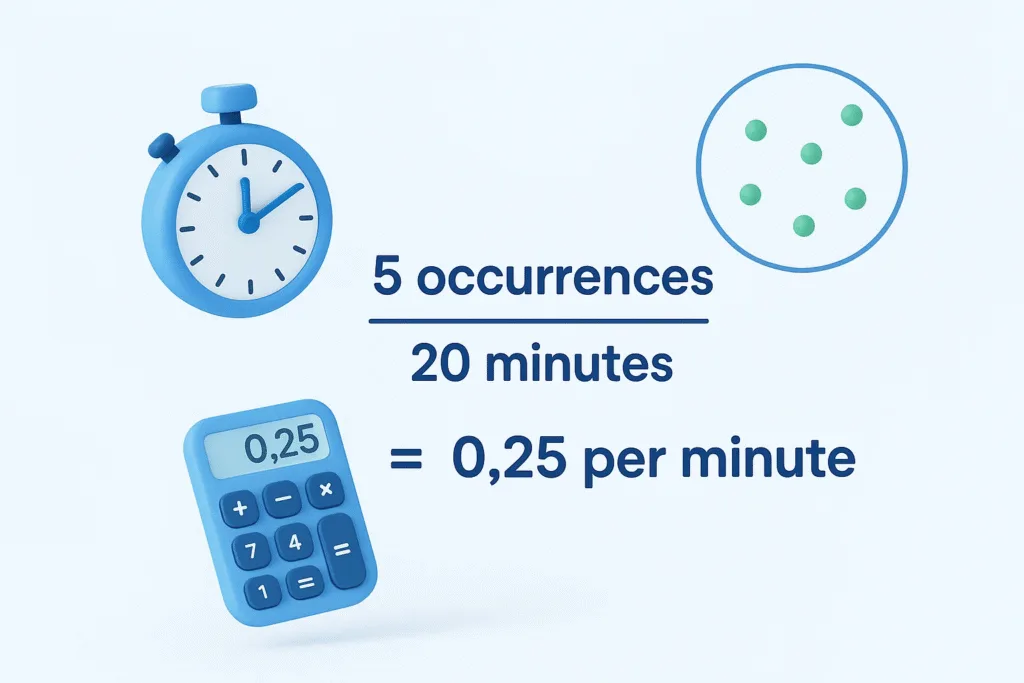
Many candidates misread these RBT exam tricky questions. If the question had said “the child engaged in the behavior for 5 minutes,” that would be a duration measure, not rate. Careful reading of words like “occurrences,” “duration,” and “per minute” is key.
→ Our FREE RBT Practice Test includes 15+ measurement questions just like these with step-by-step explanations for every answer. See if you can get the math right when it counts.
2. Identifying Functions of Behavior in Scenarios
These questions test whether you can identify why a behavior happens and choose an intervention that matches that function.
The RBT Task List connects this to D-2 (common functions of behavior), B-3 (help with functional assessment), and D-3/D-4 (apply antecedent strategies or differential reinforcement based on function).
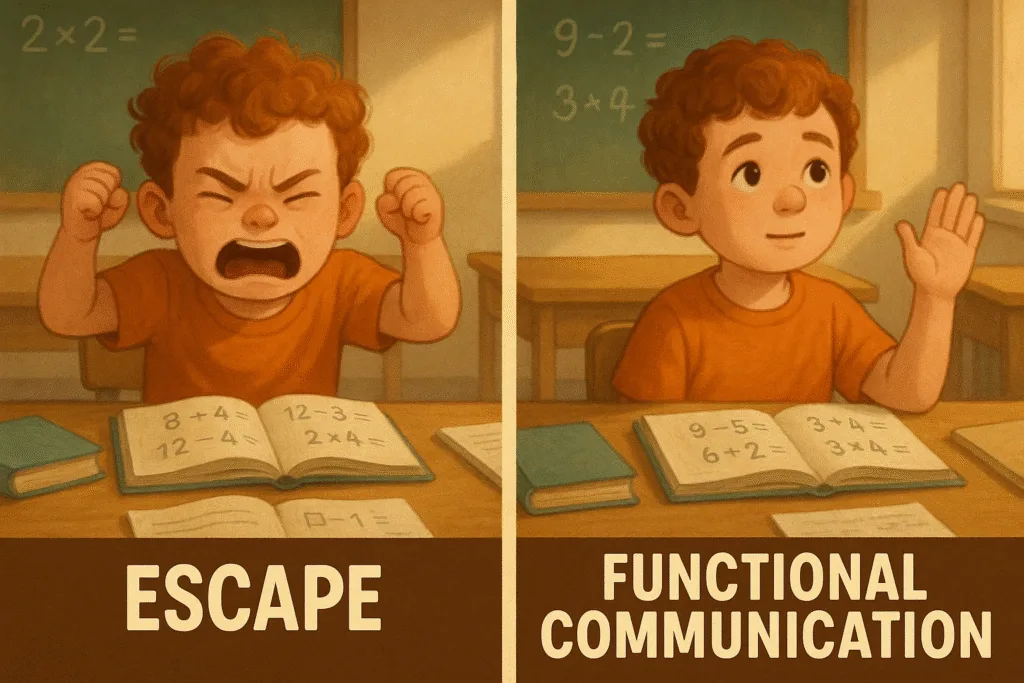
A typical item will give you a scenario, like a child throwing tantrums during math class, and ask either:
- What function is maintaining the behavior (attention, escape, tangible, or automatic)?
- Which intervention directly addresses that function?
Sample Question (Illustrative)
A BCBA finds that a child’s aggression is maintained by escape from demands. Which intervention directly addresses this function?
A) Give attention when aggression occurs
B) Provide a preferred item after appropriate behavior
C) Teach a communication response for requesting breaks (escape)
D) Apply time-out whenever aggression occurs
Answer & Rationale
Correct answer: C) Teach a communication response for requesting breaks.
Reasoning: If the function is escape, then teaching the child to appropriately ask for a break (Functional Communication Training) provides the same outcoreinforme as the problem behavior but in an acceptable way.
- Option A (attention): mismatched, as attention is not the function.
- Option B (preferred item): gives tangibles, not escape.
- Option D (time-out): can actually reinforce escape because it removes the demand.
→ Can you tell the difference between escape and attention functions in complex scenarios? Practice our FREE RBT Practice Test that includes realistic behavior scenarios that test your function identification skills.
3. Ethics & Professional Conduct
Ethics questions are among the most critical RBT exam question types because they directly impact professional practice. These RBT exam tricky questions test knowledge of the BACB Professional and Ethical Compliance Code.
They involve tasks from F-1 to F-5, such as supervision, professional communication, boundaries, and protecting client dignity.
A typical scenario may describe receiving a gift from a family, seeing a supervisor break protocol, or facing a personal legal issue, then ask what the RBT is ethically required to do.
Sample Question (Illustrative):
In which situation must an RBT self-report to the BACB?
A) Observes a colleague making a mistake in a procedure (no harm)
B) Receives a speeding ticket (no client risk)
C) Arrested for driving under the influence (DUI)
D) Disagrees with a behavior plan professionally
Answer & Rationale:
The correct answer is C) Arrested for DUI.
According to the BACB code, RBTs must self-report legal or ethical violations that affect professional trust and client safety.
A speeding ticket (B) is minor and not reportable. A colleague’s mistake (A) should be reported to a supervisor, not the BACB. A disagreement (D) is professional and not misconduct. Only legal arrests (like DUI) meet the threshold for required self-reporting.
4. Reinforcement vs. Punishment & Differential Reinforcement Questions
These RBT exam tricky questions test core behavior analysis principles that every RBT must understand perfectly.
They often ask candidates to identify whether a consequence is reinforcement, punishment, or extinction, and whether it is positive (adding) or negative (removing).
Differential reinforcement procedures (DRA, DRO) also appear frequently. Tasks include
- C-3 (reinforcement concepts)
- D-4 (differential reinforcement)
- D-5 (extinction).
Sample Question (Illustrative):
Which of the following is an example of negative punishment?
A) Removing a toy when a child hits someone
B) Giving extra chores to a child who missed homework
C) Putting a child in time-out for screaming
D) Scolding a child for throwing a tantrum
Answer & Rationale:
The correct answer is A) Removing a toy when a child hits someone.
Negative punishment means taking away something valued to reduce behavior.
- B) Extra chores = positive punishment (adding something unpleasant).
- C) Time-out = also negative punishment (removes access), but option A is the clearest textbook example.
- D) Scolding = positive punishment (adding a reprimand).
Exams usually expect the “best” or clearest example, so careful attention to wording is key.
5. Prompting, Prompt Fading & Chaining Questions
These RBT exam tricky questions check your knowledge of how to teach skills: the order and type of prompts, how to fade them, and how to break tasks into steps (chaining). The Task List items covered are C-5 (task-analyzed chaining), C-6 (discrimination training), and C-7 / C-9 (stimulus & response prompts and fading). A typical item will describe a prompt sequence or a chaining plan and ask you to spot the error, name the risk, or choose the correct next step.
Sample / Illustrative Question
An RBT uses this most-to-least prompting sequence to teach putting on a jacket: full hand-over-hand → light touch at elbow → gesture → independent. What is the primary risk of this prompt hierarchy?
A) It may create prompt dependency (student never reaches independence)
B) It fades prompts too quickly, causing errors
C) It does not include a physical prompt option
D) It relies on natural reinforcers too early
Answer & Rationale
Correct: A) Prompt dependency.
Most-to-least starts with a high level of help (full physical). If the RBT does not fade prompts carefully, the learner may rely on the highest prompt and never perform the skill independently. B is wrong because most-to-least fades slowly, not too fast. C is false, the sequence includes a physical prompt. D is irrelevant here.
RBT Task List Sections Most Linked to Errors
Based on candidate feedback and training provider insights, these areas generate the most challenging RBT exam question types:
- Measurement/Data (A-2 to A-6): Frequency, duration, interval recording, graphing
- Functional Assessment (B-3, D-2 to D-5): Functions, extinction, differential reinforcement
- Prompting & Chaining (C-5 to C-9): Task analysis, discrimination, fading
- Reinforcement Principles (C-3, D-4, D-5): Schedules, DRO/DRA, extinction
- Ethics & Conduct (F-1 to F-5): Supervision, communication, boundaries
These areas are hard because the exam often uses tricky wording like “NOT” or “most appropriate.”
Some questions need several steps of reasoning, such as reading data and then matching it to an ABA rule.
Others are math-heavy or combine more than one concept at the same time. Scenarios also add extra details that are not important, so you must learn to ignore the noise and focus on the main idea.
Final Study Strategies for Tricky RBT Exam Questions
Preparing for the RBT exam tricky questions requires more than rote memorization. You need to master different RBT exam question types and apply smart RBT exam preparation tips to boost your confidence and accuracy.
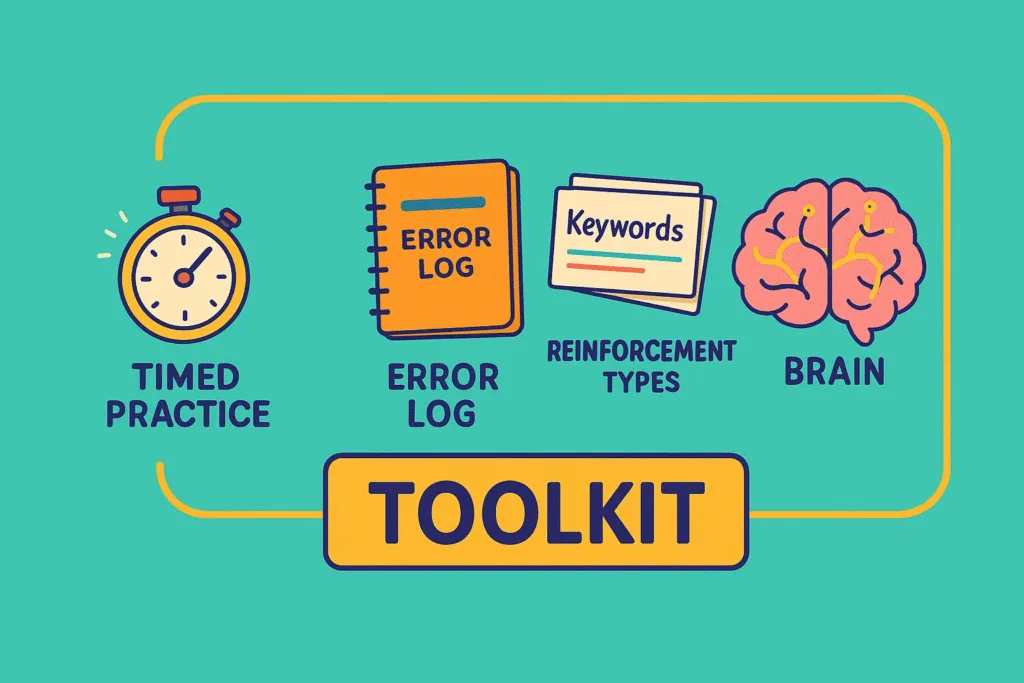
- Active Scenario Practice
Focus on realistic case-style questions instead of just memorizing definitions. After answering, explain why each wrong option is incorrect—this strengthens discrimination skills.
- Keyword Spotting
Train your eye for exam signal words like NOT, most appropriate, directly addresses, required. You can underline or mentally mark these to avoid misreading traps.
- Domain Mapping
Always connect the question back to its Task List domain (e.g., data = Task A, ethics = Task F). This narrows down choices logically, even if the scenario feels confusing.
- Error Log Review
Keep a notebook of every practice mistake. Write the correct answer with rationale, then review before the exam. This is one of the simplest yet most effective RBT exam preparation tips to stop repeating errors.
- Timed Drills
Practice under time pressure with mixed-domain sets. This reduces panic when encountering multi-step data or wording-heavy ethics items on the real exam.
- Visual Aids & Quick Charts
Keep simplified charts for reinforcement types, functions of behavior, and prompting sequences. Use them for quick recall in the last week before exam day.
→ Ready to put these strategies to the test? Our FREE Practice RBT Exam features the exact types of tricky questions we just covered. See if you can spot the keywords, identify functions correctly, and handle those complex scenarios. Take the test that shows you what you really know.
Conclusion
Remember that feeling when you first opened the RBT Task List and thought, “How am I ever going to master all of this?”
Now look at where you are, equipped with insights into the most challenging RBT exam tricky questions and armed with proven RBT exam preparation tips that many candidates never discover.
The reality is, the exam isn’t just about what you know.
The toughest RBT exam question types are designed to test how you think under pressure, how you apply ABA principles to real situations, and whether you can cut through distractors to find the heart of each problem.
Your RBT certification is only the beginning.
The critical thinking skills you’ve developed while working through difficult RBT exam question types, the ethical framework you’ve built, and the confidence gained from applying consistent RBT exam preparation tips will serve you well beyond exam day throughout your entire career in behavior analysis.
→ You’ve learned the strategies, but can you execute them under pressure? Our FREE Practice Exam reveals your blind spots in these 5 tricky question types. Stop guessing about your readiness, get the data you need to pass with confidence.
Now go and show what you’re made of. You’ve earned this moment, and more importantly, you’re ready for it.