
You know the SEAT framework backwards and forwards. Sensory, Escape, Attention, Tangible. You’ve memorized what are the 4 functions of behavior RBT students need to know, and taken the practice tests.
But then exam day comes, and you see this:
“A client completes academic work independently with 90% accuracy. During group activities with peers, the client engages in elopement. When redirected to solo work at the same difficulty level, elopement stops. The function is most likely…”
Your brain screams “ESCAPE!” You pick it, and move on. And later, you find out you got it wrong.
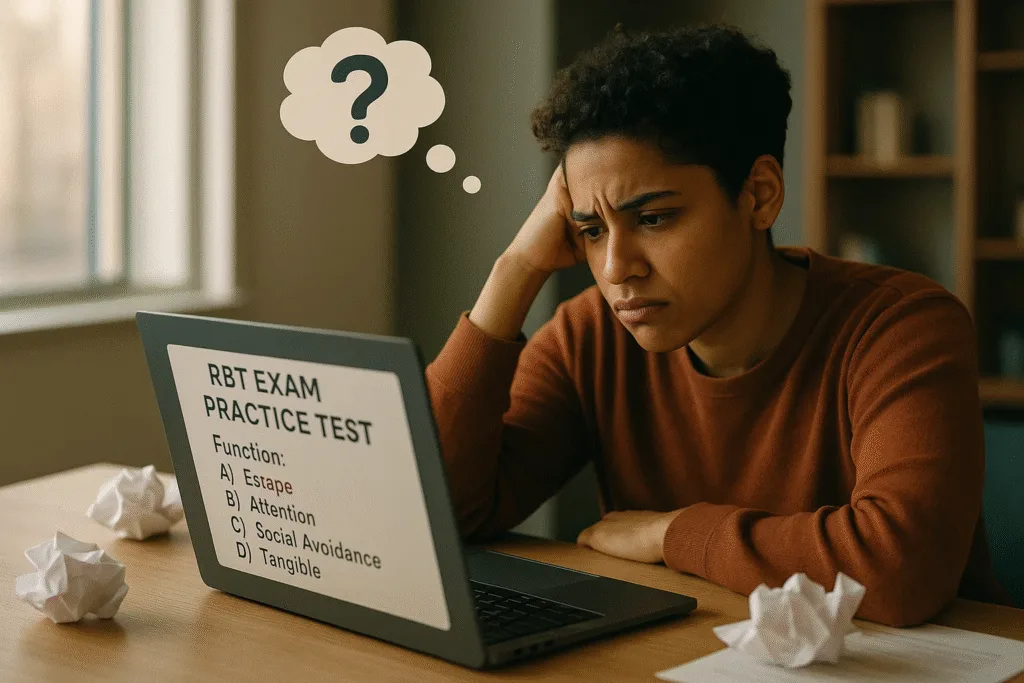
What just happened?
SEAT is just the beginning. It’s the foundation,but RBT exam questions don’t stop there. They love to throw scenarios at you where SEAT looks like the right answer… but isn’t.
And that’s exactly why you keep second-guessing yourself.
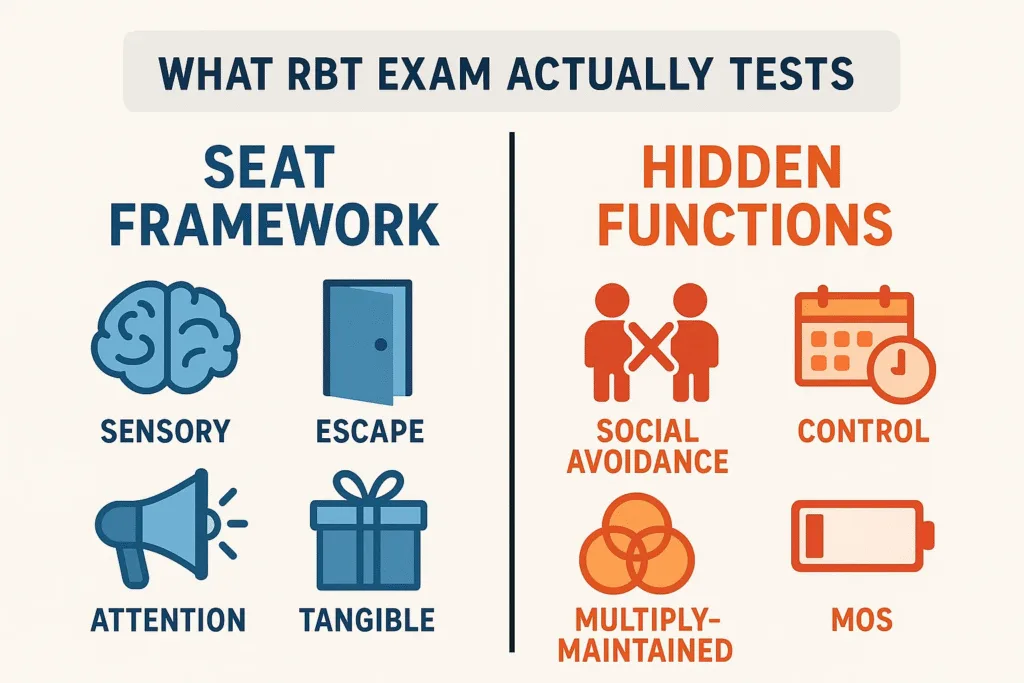
We’ve prepared this guide to solve the problem. We’re going to break down the 4 hidden functions of behavior ABA that show up on the RBT exam again and again, and show you exactly how to spot them so you stop falling for the traps.
Let’s dive in.
→ Think you’ve got this down? Put it to the test. Our free RBT mock exam shows you exactly which hidden functions you’ve mastered, and which ones need a little more love before exam day.
Quick Review of SEAT Framework
In Applied Behavior Analysis (ABA), the SEAT framework helps identify why a behavior happens. When studying what are the 4 functions of behavior RBT courses teach, you’ll start with these basics: simple, quick to grasp, and perfect for new RBTs or for analyzing straightforward behaviors.
For example, it can help explain why a child flaps their hands, screams, or throws a tantrum.
There are four standard functions of behavior ABA professionals use in the SEAT framework:
| Function | Description | Example |
| Sensory (Automatic Reinforcement) | Behavior itself feels good. Happens even when the person is alone. | Hand-flapping because it feels pleasurable |
| Escape (Negative Reinforcement) | Behavior removes or avoids something unpleasant. Helps get away from tasks, demands, or people. | Tantrum to avoid homework |
| Attention (Social Positive Reinforcement) | Behavior gets attention from others. Any attention counts—even negative. | Screaming to make the teacher notice |
| Tangible (Access to Item/Activity) | Behavior gets something concrete. The goal is a specific item or activity. | Hitting to get an iPad |
But is the SEAT framework always useful?
Not really. It is useful only when:
- Teaching basics to new RBTs
- Quick screening tools (like FAST or MAS)
- Simple, clear-cut behaviors
It is not useful when the kid:
- Fails when multiple functions operate at the same time
- Doesn’t capture subtle or context-dependent motivations
- Social functions can be complex.
Which Behaviors Seat Can’t Fully Explain?
While the SEAT framework is a helpful starting point, it has limitations. There are behaviors that SEAT simply cannot explain.
Understanding the hidden functions of behavior ABA practitioners encounter is essential for passing your RBT exam. Let’s explore them.
Hidden Function #1: Social Avoidance (Different from Escape)
Sometimes a client isn’t avoiding the task, they’re avoiding the people. They can do the work just fine, but being around others feels overwhelming. SEAT often calls this “Escape,” but typical escape strategies don’t work.
For example:
A client might flap their hands or have a tantrum during group activities but finish the same work alone without issue. Here, the behavior is about avoiding social interaction, not avoiding the task. Look for behavior that only happens in social settings, while solo work is fine, or if they avoid eye contact or proximity to others.
This occurs when the behavior isn’t about avoiding the task itself, but rather avoiding social interaction.
A client may be capable of completing the work but struggles with the presence of others. SEAT often mislabels this as “Escape,” which is incorrect.
For example:
A client may engage in self-injurious behavior during group activities but completes the same task independently without issue. Here, the function is avoiding social proximity, not the work itself.
RBT Exam Scenario Pattern: “Client completes work quietly when alone but tantrums during group instruction. Task difficulty is the same. Function is most likely: ___”
Red Flags on Exam:
- Behavior occurs in social settings only
- Task completion is fine when alone
- Avoids eye contact, proximity to peers
Hidden Function #2: Control/Predictability
Some behaviors happen because the client wants to control what’s happening or stick to a predictable routine. When examining what are the 4 functions of behavior RBT tests assess, SEAT might mislabel this as Tangible or Escape, but it’s actually about keeping things predictable.
For example:
A client may scream or refuse a new activity if the schedule changes unexpectedly. Give a heads-up, and they transition calmly.
RBT Exam Scenario Pattern: “Client engages in aggression when daily schedule is changed without warning, even if the new activity is preferred. When given advance notice, the client transitions calmly. Function is most likely: ___”
Red Flags on Exam:
- Behavior during transitions or unexpected changes
- Calms down when given warning/choice
- Doesn’t matter if change is “good” or “bad”
Hidden Function #3: Multiple Functions (Multiply-Maintained Behavior)
Some behaviors serve more than one purpose, depending on the situation. While the standard functions of behavior ABA teaches assume one function per behavior, this can be misleading on your RBT exam.
For instance:
A client may hit during math to escape the work, hit during free time for attention, and hit when denied an iPad to get it. Same behavior, but three different reasons.
RBT Exam Scenario Pattern: “ABC data shows client engages in property destruction during difficult tasks, during independent work when staff attention is low, AND when preferred items are removed. This suggests: ___”
Answer Options Usually Include:
- A) Single function – Escape
- B) Single function – Attention
- C) Multiple functions operating
- D) Automatic reinforcement
Correct Answer: C (Multiple functions)
Red Flags on Exam:
- ABC data shows different patterns in different contexts
- Behavior happens across multiple settings with different outcomes
- Question asks about “data from multiple observations”
→ Ready to test your new skills? Take a free RBT mock exam and watch yourself spot those hidden functions like a pro. No signup required—just you vs. the tricky questions you now know how to handle.
Hidden Function #4: Establishing Operations (MOs) Complicate Everything
Sometimes the reason for a behavior changes depending on hunger, fatigue, or other needs. The behavior looks the same, but the underlying reason is different.
For example:
A client might ask for a break in the morning because they’re avoiding a task (Escape), but in the afternoon, the same request is really about needing rest or food (Tangible). Exams often hint at this by mentioning meals, sleep, or time of day.
RBT Exam Scenario Pattern: “A client typically engages in elopement to escape demands. Today, the client elopes during preferred activities. Staff notes the client missed breakfast. The current function is most likely: ___”
Red Flags on Exam:
- Behavior changes when biological needs change
- Question mentions time of day, meal schedule, sleep
- “Typically serves X function, but today…”
How to Identify Hidden Functions? (Advanced FBA Skills for RBTs)
Sometimes behaviors don’t fit neatly into what are the 4 functions of behavior RBT basics teach. To understand the real reason behind a behavior, RBTs need to dig a little deeper. One helpful method is the Context Matrix Approach.
What is the Context Matrix Approach?
| Context Variable | Questions to Ask | Why It Matters |
| Time of Day | Morning or afternoon? Before/after meals? | Hunger, fatigue, or other biological needs can change motivation |
| Social Setting | Alone, 1:1, small group, large group? | Shows if behavior is social avoidance or attention-seeking |
| Task Demands | Easy or hard? Preferred or non-preferred? | Differentiates true escape from control or predictability issues |
| Transition Type | Expected or unexpected? | Helps identify control/predictability functions |
| History | What happened 5 min ago? Yesterday? | Reveals establishing operations that may drive behavior |
The “Why Isn’t This Working?” Test
If a SEAT-based intervention fails, follow these steps:
Step 1: Review the Data
- Is the behavior decreasing? If not, the function may be wrong.
- Is the replacement behavior increasing? If not, the replacement might not match the function.
Step 2: Ask Questions
- Does the behavior happen in all contexts or just some?
- Does it happen with all people or only certain individuals?
- Does the consequence matter, or does the behavior happen anyway?
Step 3: Consider Hidden Functions
- Could this be social avoidance, not task escape?
- Could it be about control, not access?
- Could multiple functions be happening at once?
Exam Example:
“An RBT implements a DRA procedure where the client is taught to request a break instead of engaging in SIB. Data shows SIB continues at high rates. The BCBA should consider: ___”
Answer: The function may be misidentified or the behavior may have multiple functions.
Which Functions Are Commonly Misidentified In RBT Exam?
Here are five RBT exam traps to watch for when identifying functions of behavior ABA.
Trap #1: “Looks Like” Doesn’t Mean “Is”
Sometimes a behavior appears to be a classic Escape, but context tells a different story.
Example Trap Question:
Client engages in tantrums when asked to complete preferred art activity. The client enjoys art and completes it successfully when working alone. During group art, tantrums occur. Function is most likely: ___
Student Thinking: “Tantrum to get out of task = Escape” ❌
Correct Thinking: Client does art happily alone, so not escaping the task. Tantrums only during GROUP art = Social avoidance ✓
Key Words to Watch:
- typically enjoys
- completes successfully when
- only occurs during group/social
Trap #2: Attention Isn’t Always Attention
Not every behavior that draws a response from an adult is for attention. This is a common mistake when learning what are the 4 functions of behavior RBT exams test.
Example Trap Question: Client hits peers during cooperative learning. Teacher intervenes by redirecting client to solo work. Hitting continues. Function is most likely: ___
Student Thinking: “Adult responded = Attention function” ❌
Correct Thinking: Client gets to work alone (removed from social situation) = Social avoidance/Escape from peers ✓
Exam Keywords:
- “removed from” = probably escape/avoidance
- “approaches staff” = probably attention
- “given reprimand” = attention (any attention counts)
Trap #3: Tangible vs. Control Confusion
Behaviors that result in obtaining a preferred item aren’t always Tangible.
Example Trap Question: Client screams when told ‘no iPad until homework done.’ When given choice between iPad now vs. iPad after homework, client chooses iPad after homework without screaming. Function is most likely: ___
Student Thinking: “Wants iPad = Tangible” ❌
Correct Thinking: Having a choice (control) stopped behavior, not getting iPad immediately. About control, not the item. ✓
Key Clue: If giving choice/warning fixes it → Control function
If only getting item fixes it → Tangible function
Trap #4: Automatic vs. Multiply-Maintained
Behaviors that occur when alone aren’t automatically sensory. This is a critical concept in functions of behavior ABA.
Example Trap Question: ABC data shows client engages in hand-biting when alone (5 times), during difficult tasks (12 times), and when denied access to computer (8 times). Function is most likely: ___
Student Thinking: “Happens when alone = Automatic” ❌
Correct Thinking: Happens MOST during demands and denial = Escape + Tangible are primary. Also happens alone sometimes = Multiply-maintained ✓
Trap #5: The “Typically” Trick
RBT exam questions often include phrasing like “typically functions as X, but today…”
Example Trap Question: Elopement typically functions to escape demands. Today, client elopes during preferred activities. Client missed lunch. Current function is most likely: ___
Student Thinking: “Always escape, so still escape” ❌
Correct Thinking: MO changed (hunger). Currently seeking food/break = Tangible ✓
Exam Keywords:
- typically
- usually
- today
- currently
- missed meal/sleep
Strategy: When you see “typically” vs. “today,” focus on what’s DIFFERENT today
What’s the Best Study Strategy To Spot Functions in RBT Exams?
The best way to identify functions of behavior ABA on the RBT exam is to follow a step-by-step approach. Start by reading the scenario carefully and notice the context, what happened before the behavior, the behavior itself, and the consequence.
Step 1: Does the behavior happen in different situations with different results?
- Yes → It’s likely multiply-maintained (more than one function).
- No → Go to the next step.
Step 2: Does it only happen in social settings but not when alone?
- Yes → Think social avoidance or attention.
Step 3: Does giving a choice or warning stop the behavior?
- Yes → It’s probably about control or predictability.
Step 4: Did something change in the client’s body or needs? (e.g., missed meal, tired, sick)
- Yes → Motivation might be affecting the behavior.
Step 5: If none of the above, use the standard SEAT framework: Escape, Attention, Tangible, or Sensory.
Here’s a memory tip for you. Use SCAMS to remember hidden functions:
- Social avoidance
- Control/predictability
- Automatic (sensory)
- Multiply-maintained
- Standard SEAT

| Practice Plan | |||
| Day 1–2 | Day 3-4 | Day 5-6 | Day 7 |
| Review SEAT functions | Practice 30 questions on social avoidance vs. escape | Practice 30 questions on control vs. tangible | Practice 50 mixed questions on all hidden functions |
Try These RBT Exam-Style Function Questions
Question 1: Social Avoidance
A client completes academic tasks independently with 90% accuracy. During cooperative learning activities with peers, the client engages in elopement. When redirected to solo work at same difficulty level, elopement stops. The function of elopement is most likely:
A) Escape from academic demands
B) Attention from peers
C) Escape from social interaction ✓
D) Automatic reinforcement
Why C:
- Does work fine independently (not escaping task)
- Only happens during peer interaction (social context)
- Solo work (same difficulty) = no problem
Question 2: Multiply-Maintained
ABC data over 2 weeks shows: (1) Client screams during math worksheets – removed from task, (2) Client screams during free play when staff attention is low – staff approaches, (3) Client screams when iPad is removed – iPad returned. This suggests:
A) Primary function is escape
B) Primary function is attention
C) Multiple functions across contexts ✓
D) Automatic reinforcement
Why C:
- Different contexts = different consequences
- Escape during demands
- Attention during low-attention periods
- Tangible when item removed
- Can’t pick just one
→ Want more practice like this? Our free RBT mock tests are loaded with 100+ questions just like these, complete with explanations. No signup, no catch.
Question 3: MO Influence
A client typically requests breaks to escape difficult tasks. Today, the client requests breaks during preferred activities. The client missed breakfast and lunch. The current function of break requests is most likely:
A) Escape from demands
B) Access to food/rest ✓
C) Attention from staff
D) Automatic reinforcement
Why B:
- “Typically” escape, but “today” different
- Biological state changed (missed meals)
- MO (hunger) changed motivation
- Now seeking access (tangible), not escape
Conclusion
By now, you understand what trips up most RBT exam students: the test goes beyond basic what are the 4 functions of behavior RBT courses teach.
You can differentiate social avoidance from escape, control from tangible, and notice when “typically” signals a function has shifted. With SCAMS and your decision tree, you’re ready to spot the subtle traps in functions of behavior ABA questions.
Here’s the plan…
Start with 30 practice questions on social avoidance vs. escape (Days 1–2), then 30 on control vs. tangible (Days 3–4), and finish with 50 mixed questions (Days 5–7).
On RBT exam day, if you face a long scenario with lots of context, they’re looking for the hidden function. Follow your decision tree and ask: “What consequence does this behavior produce?” That’s your guide.
Those functions of behavior ABA questions that once felt intimidating are now the ones you can tackle with confidence.
→ You’ve got the knowledge. Now it’s time to practice. Try our free RBT mock test and see these hidden functions come to life in real exam scenarios. Start your Day 1 practice right now.
You’ve prepared strategically. Now it’s time to put that preparation into practice. Your RBT credential is within reach.