A client engages in hand-flapping. The RBT reinforces the client for keeping hands clasped together. This is an example of:
A) DRA
B) DRI
C) DRO
D) DRL
What would be your answer? Is clasping hands incompatible? Or is it an alternative? Or… was this the absence of one?
You’ve seen differential reinforcement RBT in your 40-hour training. You studied it many times. But right now, under pressure, DRA, DRI, DRO, and DRL all look the same.
It’s one of the most confusing areas of applied behavior analysis RBT exam. These 4 procedures show up 6-8 times on your exam which is nearly 8% of your total score. You can’t afford to miss them.
But here’s the good news…
Once you understand the decision-making framework behind these procedures, you’ll answer these questions in 10 seconds flat.
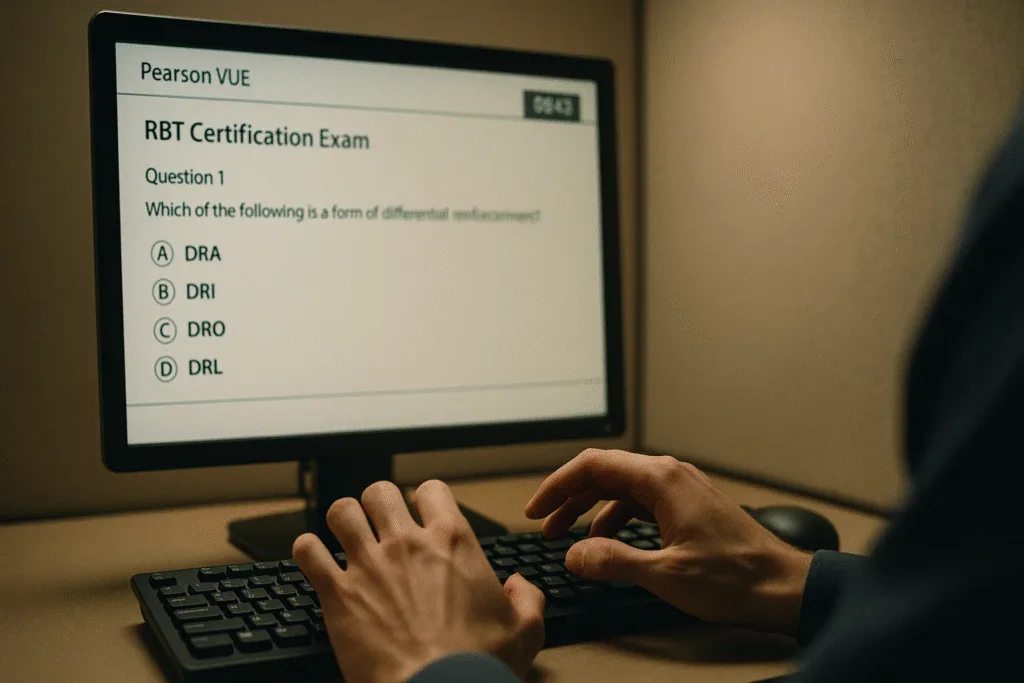
In this guide, you’ll learn the one question that separates DRA from DRI, the “RAIL” memory trick, the 5 exam traps that trick even prepared candidates, and a decision tree you can run through in seconds. By the end of this post, differential reinforcement RBT won’t be your weakness.
Let’s start.
Test your current knowledge with our free RBT practice exam covering all 6 task list sections. No signup required.
What is Differential Reinforcement RBT?
Here’s how differential reinforcement RBT looks like in practice:
Reinforce This → DON’T Reinforce That
This is the entire concept. You pick one behavior to strengthen with reinforcement, and you ignore (put on extinction) all the other behaviors.
Example:
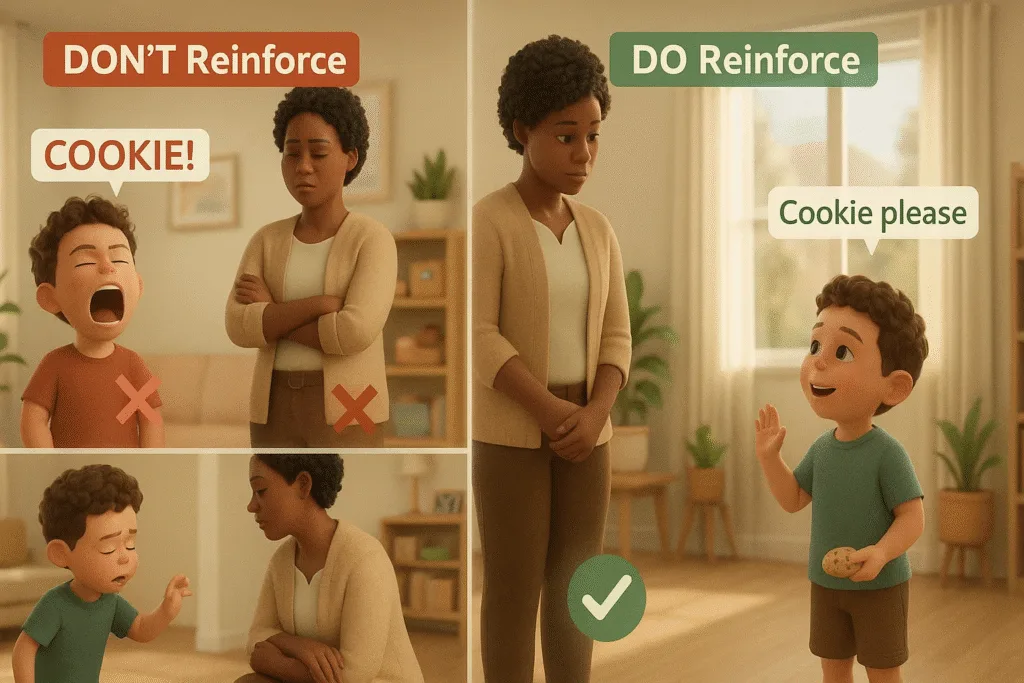
Scenario: A kid wants a cookie.
What happens:
- Kid screams “COOKIE!” → You ignore (no reinforcement)
- Kid throws toys → You ignore (no reinforcement)
- Kid whines → You ignore (no reinforcement)
- Kid says “Cookie please” → You give cookie (reinforcement!)
You reinforced one behavior (polite asking) and ignored all the others (screaming, throwing, whining). This is differential reinforcement RBT.
Why “differential”?
Because you’re treating behaviors differently. Some get reinforced, some don’t.
- This behavior = gets reinforced ✓
- Those behaviors = get nothing ✗
There are four types of differential reinforcement RBT that candidates must master for the RBT exam:
| Type | What You Reinforce | When to Use |
| DRA | Alternative behavior | Teaching a replacement behavior |
| DRI | Incompatible behavior | When behaviors can’t happen simultaneously |
| DRO | Absence of behavior | High-rate or dangerous behaviors |
| DRL | Lower rates | Reducing frequency, not eliminating |
Complete Breakdown of Four Types of Differential Reinforcement RBT
- DRA – Differential Reinforcement of Alternative Behavior
In the DRA ABA procedures, you teach a different and appropriate behavior to replace the problem behavior. But there’s something that might create confusion. Both behaviors can physically happen at the same time.
Let’s see this setup:
- Problem behavior: Screaming for toy
- Alternative behavior: Asking “Can I have a toy please?”
- Your job: Reinforce asking, ignore screaming
A kid could scream and ask politely at the same time (unlikely, but physically possible). That’s DRA ABA.
Example:
Let’s say a child throws materials when frustrated.
Step 1: Identify the problem (i.e., throwing materials).
Step 2: Pick an alternative (i.e., teach them to say “I need a break”).
Step 3: Implement it
- When they throw → ignore, redirect, no reinforcement
- When they ask for break → immediately reinforce (give the break)
Step 4: Check your work
- Can they throw materials and say “I need a break” simultaneously?
- Yes, technically. They could be throwing while saying the words. Both behaviors can co-occur. That’s why this is DRA, not DRI.
In the RBT exam, you’ll see questions like this:
A client engages in hitting to get attention. The RBT teaches the client to tap the teacher’s shoulder instead. When the client taps, attention is provided. This is: ___
Answer: DRA. Because they could hit and tap at the same time (though we’re teaching them not to).
Here are some of the words that indicate DRA:
- Teaches an alternative
- Replacement behavior
- Functionally equivalent
- Instead of [problem], the client learns to [appropriate behavior]
When you see these phrases on your RBT exam, your brain should think: Are both physically possible at once? If yes, mark DRA ABA.
- DRI – Differential Reinforcement of Incompatible Behavior
DRI is about physical impossibility. You reinforce a behavior that literally cannot happen at the same time as the problem behavior. Can’t do both at once? That’s your DRI signal.
Let’s see this setup:
- Problem behavior: Running around classroom
- Incompatible behavior: Sitting in chair
- Reality check: Can you run and sit at the same time?
No. Physically impossible. That’s DRI.
Before you answer any RBT exam question, ask yourself: Can this person physically do both behaviors right now, at the exact same moment?
NO = DRI ✓
YES = DRA ✓
Examples:
Example 1: Client hits staff
→ Teach: Keep hands in pockets
→ Test: Can you hit someone while your hands are in your pockets? No. DRI.
Example 2: Client bites their fingers
→ Teach: Hold a toy with both hands
→ Test: Can you bite your fingers while both hands are gripping a toy? No. DRI.
Example 3: Client leaves their seat during work
→ Teach: Remain seated
→ Test: Can you leave your seat while seated? No. Mutually exclusive. DRI.
In the RBT exams, you’ll see questions like this:
A client engages in standing up during circle time. The RBT reinforces the client for sitting. This is: ___
Your thought process:
- Can they stand and sit simultaneously?
- No.
- Mark DRI.
Here are some of the words that indicate DRI:
- Cannot occur at the same time
- Incompatible with
- Mutually exclusive
- Physically impossible
- DRO – Differential Reinforcement of Other Behavior
In DRO applied behavior analysis, you reinforce the absence of the problem behavior during a set time interval. You don’t care what they’re doing instead – playing, sitting, staring at the wall – as long as they’re NOT doing the problem behavior.
This is the “anything but” approach. No hitting for 5 minutes? Reinforcement. What were they doing instead? Doesn’t matter.
Let’s see this setup:
- Problem behavior: Screaming
- Time interval: 5 minutes
- Rule: If NO screaming for 5 minutes → deliver reinforcement
- What they did instead: Playing? Walking? Humming? All fine. You’re not teaching a specific replacement.
Example:
Let’s say a client has tantrums 20 times per hour. That’s constant. You need immediate reduction.
Here’s your DRO applied behavior analysis plan:
- Set a timer for 3 minutes
- Watch for tantrums
- If the 3 minutes pass with NO tantrum → give reinforcer
- If tantrum happens at minute 2 → reset timer, start over, no reinforcement
During those 3 minutes, the client might be drawing, staring out the window, humming, pacing – whatever. As long as there’s no tantrum, they earn reinforcement.
Then you gradually increase the interval: 3 minutes → 5 minutes → 10 minutes. You’re stretching out the time they can go without the problem behavior.
In the RBT exam, you’ll see question like:
The RBT provides reinforcement if self-injury does NOT occur for 10 minutes. This is: ___
Answer: DRO.
Here are some of the words that indicate DRO applied behavior analysis:
- Absence of behavior
- Does not occur for [X minutes]
- Any other behavior
- Interval-based reinforcement
- DRL – Differential Reinforcement of Low Rates
You reinforce when the behavior happens less often than it used to. This is the only differential reinforcement RBT where the behavior is appropriate. You’re just dialing down the volume.
Let’s see this setup:
- Behavior: Hand-raising in class
- Current rate: 30 times per class
- Target rate: 10 times or less
- Rule:
- If ≤10 hand-raises → reinforcement
- If >10 → no reinforcement
The behavior (hand-raising) is fine. Thirty times is just excessive.
There are two types of DRL:
| Full-Session DRL | Interval DRL |
| You count total occurrences across the entire session. | The client must wait a certain amount of time between behaviors. |
| Example: If the student raises their hand 10 times or fewer during the 50-minute class, they earn reinforcement at the end. | Example: The student can ask a question, but they must wait at least 5 minutes before asking the next one. |
Example:
Let’s say a client requests attention 50 times per hour. Here’s your DRL plan:
- Baseline: 50 requests/hour (measure current rate)
- First target: 30 or fewer → reinforcement
- Second target: 20 or fewer → reinforcement
- Third target: 15 or fewer → reinforcement
- Final target: 10 or fewer → reinforcement
You’re progressively reducing over weeks. Each time they hit the target, they earn reinforcement. No reinforcement that session if they’re over the target.
In the RBT exam, this appears as:
A client appropriately asks for help, but does so 40 times per session. The RBT provides reinforcement if the client asks 15 times or fewer. This is: ___
Answer: DRL.
Here are some of the words that indicate DRL:
- Reduce frequency
- Lower rate
- Decrease but not eliminate
- Less than [number] times
- Appropriate behavior occurring too often
Pause Here: Ready to Test What You Just Learned?
You now understand the 4 types of differential reinforcement. But can you identify them in exam scenarios? Try last-minute and quick RBT practice questions using what you just learned to test your understanding.
How to Answer any DR Question in 10 Seconds?
Here’s the framework to answer any differential reinforcement RBT question in 10 seconds on your RBT exam:
START: Read the question
↓
Q1: Are they trying to REDUCE but NOT eliminate?
YES → DRL ✓
NO → Continue
↓
Q2: Are they reinforcing ABSENCE of behavior?
YES → DRO ✓
NO → Continue
↓
Q3: Are they teaching SPECIFIC replacement behavior?
YES → Continue to Q4
NO → Re-read question
↓
Q4: Can BOTH behaviors happen at the SAME time?
YES → DRA ✓
NO → DRI ✓

There are two tricks you can use to answer correctly:
- “RAIL” memory trick.
Reduce rate = DRL Absence of behavior = DRO Incompatible (can’t do both) = DRI Learn alternative (can do both) = DRA
- Elimination method.
- DRL mentions numbers/rates? (If no, eliminate)
- DRO mentions time interval + absence? (If no, eliminate)
- Between DRA and DRI? Do the physical test
Common Exam Traps & How to Avoid Them
- Trap #1: DRA vs DRI Confusion
They use “instead” in DRI questions to trick you on the RBT exam. You just have to ignore the word “instead.” Instead, ask the physical test:
- Can both behaviors happen at the exact same time?
Example: The RBT teaches the client to sit instead of standing. This is DRA ABA.
Can you sit and stand simultaneously? No. Physically impossible. That’s DRI.
The word “instead” appears in both DRA ABA and DRI questions. Run the physical test every time.
- Trap #2: DRO Disguised as Teaching
The question mentions what the client is doing during the interval such as, playing with blocks, drawing, sitting quietly. It feels like you’re teaching that behavior, so you pick DRA or DRI.
Look for two things:
- Time intervals (3 minutes, 5 minutes, 10 minutes)
- The phrase “does NOT occur”
If both are present and there’s no mention of teaching that specific behavior, it’s DRO applied behavior analysis.
- Trap #3: DRL Seems Like DRO
Both involve reducing behavior, so students mix them up constantly. Just use this table on the RBT exam for quick distinction:
| DRL | DRO |
| Behavior still occurs (just less) | Behavior completely absent in interval |
| “10 or fewer times” | “Zero times for X minutes” |
| Appropriate behavior | Usually problem behavior |
Here’s a quick test:
- Does the question say “reduce but not eliminate”? → DRL
- Does it say “does not occur for 5 minutes”? → DRO applied behavior analysis
- Trap #4: Overthinking the Question
The RBT exam question gives you a detailed backstory such as the client’s history, the setting, what happened yesterday, the supervisor’s concerns. You read everything and confuse yourself.
Focus on 3 things only.
- Is there a number or rate mentioned? (10 times, 30 times, fewer than X)
→ Probably DRL - Is there a time interval + absence? (5 minutes, no behavior occurs)
→ Probably DRO - Is a specific behavior being taught?
→ Run the physical test: Can both happen at once?
→ Yes = DRA | No = DRI
- Trap #5: Function of Behavior Distraction
Function doesn’t determine differential reinforcement type on your RBT exam. It helps you design the intervention (what replacement behavior to teach, what reinforcer to use). But it doesn’t tell you whether it’s DRA ABA, DRI, DRO applied behavior analysis, or DRL.
Focus on what’s being reinforced, not why the problem behavior happens.
Example:
Client hits to escape demands. RBT teaches client to say ‘break please’ and reinforces that response.
The function (escape) is irrelevant to labeling the procedure. What matters:
- Teaching specific alternative (saying “break please”)
- Can they hit and say “break please” at once? Yes (weird, but possible)
- Answer: DRA ABA
The function (escape) tells you why hitting happens and helps you pick “break please” as the replacement. But it doesn’t change the fact that this is DRA.
Now that you know the 5 exam traps, put yourself to the test. Our free RBT mock exam includes questions designed to use every trap you just learned about. Take Full Practice Exam →
Conclusion
If the RBT exam feels hard, remember that it’s also predictable.
The test repeats the same question styles, the same traps, and even the same wording. Once you learn these patterns, the RBT exam feels less like a test of knowledge and more like a game you already know how to play.
You now have a framework of differential reinforcement RBT that works every single time:
- Is there a number/rate? → DRL
- Is there a time + absence? → DRO
- Teaching specific behavior? → Physical test → DRA or DRI
But knowledge without practice is wasteful.
You might know the decision tree perfectly, but if you don’t practice under timed conditions, it won’t help you on exam day when nerves kick in and the clock is ticking.
That’s why we created a free RBT practice test with 75+ questions modeled after the real RBT exam. It lets you practice differential reinforcement, behavior reduction, measurement, and all 6 task list sections under real test pressure.